Department of Public Service and Administration (DPSA) Circular 19 of 2026 New Jobs List

Department of Public Service and Administration (DPSA) Circular 19 of 2026 New Jobs List

Circular 19 of 2026
Full Document: Circular 19 (click here to view the full document)
Directions: Click on the name of the department / administration to view vacancies in that particular section

National Departments

Agriculture
Employment and Labour
Forestry, Fisheries and The Environment
Higher Education and Training
Home Affairs
Justice and Constitutional Development
Land Reform and Rural Development
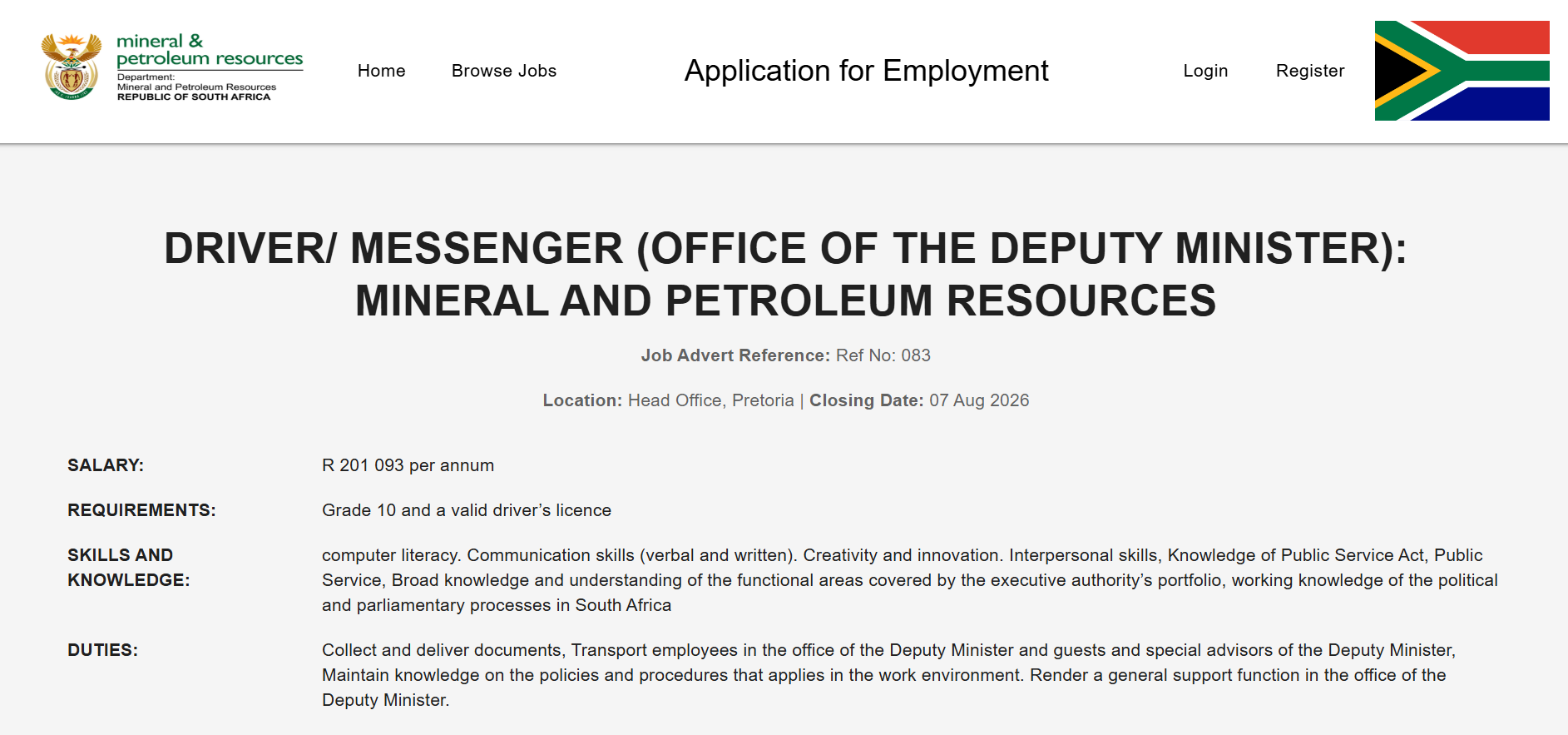
Mineral and Petroleum Resources
Municipal Infrastructure Support Agent
Office of the Chief Justice
Public Works and Infrastructure
Small Business Development
Tourism
Trade, Industry and Competition
Treasury

Provincial Administration

Gauteng
Mpumalanga
Western Cape

About The Department of Public Service and Administration (DPSA)

The Department of Public Service and Administration (DPSA) exists to establish the norms, standards, and frameworks that ensure the South African public service functions optimally, ethically, and efficiently. It acts as the central engine for government operations, driving institutional transformation and ensuring that state machinery delivers services effectively to the public.

The Department of Public Service and Administration (DPSA) is a South African national government department aimed at creating a professional, productive, and responsive public service. It establishes norms and standards for public administration, including labor relations, IT services, integrity, and anti-corruption policies across national and provincial departments.

According to Chapter 10 (Section 195 [1]) of the Constitution of the Republic, Public Administration must be governed by the democratic values and principles enshrined in the Constitution, including the following principles:

  • A high standard of professional ethics must be promoted and maintained;
  • Efficient, economic and effective use of resources must be promoted;
  • Public administration must be development–oriented;
  • Services must be provided impartially, fairly, equitably and without bias;
  • People’s needs must be responded to, and the public must be encouraged to participate in policy making;
  • Public administration must be accountable;
  • Transparency must be fostered by providing the public with timely, accessible and accurate information;
  • Good human-resources management and career-development practices, to examine human potential, must be cultivated; and
  • Public administration must be broadly representative of the South African people, with employment and personnel management practices based on ability, objectivity, fairness, and the need to redress the imbalances of the past to achieve broad representation.

ALSO CHECK: x2 Pick n Pay Graduate Buyer Opportunities for Recently Qualified Graduates with a Natural Flair for Numbers

HOW TO APPLY

Click Here To See the List of Jobs and Apply

CETA is Hiring for an Officer: Content Development and Graphic Design

CETA is Hiring for an Officer: Content Development and Graphic Design

Location: Midrand

Closing Date: 08 June 2026

Roles and Responsibilities: Officer: Content Development and Graphic Design

  • Create and write compelling content for various platforms (e.g., websites, blogs, social media, email newsletters, brochures, reports).
  • Edit and proofread content to ensure clarity, accuracy, and consistency.
  • Research and generate content ideas that align with the CETA’s branding and messaging strategy.
  • Collaborate with different departments to develop internal and external content.
  • Design and develop visually appealing graphics for marketing materials, websites, social media posts, and presentations.
  • Create templates and layouts for newsletters, reports, and brochures.
  • Ensure that designs are consistent with the CETA’s brand guidelines and visually aligned with messaging.
  • Use graphic design software (e.g., Adobe Creative Suite, Canva) to produce high-quality visuals.
  • Design engaging content for social media platforms, including infographics, banner ads, and animated visuals.
  • Assist in the creation of digital marketing campaigns by providing relevant content and visuals.
  • Maintain brand consistency in all visual and written content, ensuring that materials reflect the organization’s identity.
  • Monitor design trends and incorporate new design techniques into work.
  • Work closely with the marketing and communications team to develop and execute content strategies.
  • Communicate design ideas and content concepts clearly and effectively.
  • Maintain an organized content and design library for easy access by team members
  • Facilitate and maintain effective stakeholder and business relationships through appropriate relationship building, networking and reporting activities.
  • Represent the organisation to stakeholders, associates and partners and maintain professional, effective and amicable relationships to ensure that CETA’s interests are upheld.
  • Liaise on a regular basis with all third parties and ensure that business relationships are maintained.
  • Ensure all business activities adhere to relevant legal, regulatory, and industry standards.
  • Prepare and submit regular reports on compliance status, highlighting any potential risks or areas of non-compliance to executive management/Senior Manager.
  • Work closely with the Executive Manager/Senior Manager to implement risk controls and ensure alignment with organizational risk management goals.
  • Stay informed about regulatory changes and ensure that internal policies and procedures are updated promptly.
  • Develop own Individual Development Plan (IDP) reflecting current and future development requirements to drive personal development.
  • Identify training, certification and conference opportunities to attend that will add value to your personal development and to the CETA.
  • Remain up to date with relevant market trends and incorporate information into your work to add value. 
  • Ensure that opportunities are taken on with a “can-do attitude” and with a focus on continuous learning.

COMPETENCIES

1. Core Competencies

  • Agility
  • Result-Orientate
  • Integrity
  • Respect
  • Professionalism
  • Stakeholder Management

2. Technical Competencies

  • Writing and Editing Skills
  • Professionalism
  • Stakeholder Management
  • Market Research
  • Graphic Design Software
  • Graphic Design
  • Content Development
  • Brand Management

3. Enabling Competencies

  • Attention to Detail
  • Creativity and Innovation
  • Analytical Thinking
  • Listening Skills
  • Collaboration
  • Adaptability

Requirements

Minimum Job Inherent Requirements:

  • National Diploma (NQF6) in Graphic Design/Marketing or equivalent
  • 3 years’ experience in similar role

Remuneration and Benefits 

As per CETA’s approved Remuneration Policy and Patterson job grading framework.

This appointment is a fixed-term contract aligned to the CETA license period (expiring 31 March 2030), subject to satisfactory performance in accordance with CETA policies.

PLEASE NOTE:

Shortlisted candidates will be subject to pre-employment verifications and security vetting.

Interested applicants should send an application letter with the vacancy/position title and reference number, together with a detailed Curriculum Vitae, copies of academic qualifications and names of three contactable referees via the CETA website www.ceta.org.za

Please note the following contact details are for enquiries about JOB CONTENT ONLY and NOT for application purposes.

Enquiries: Be submitted by e-mail to molebogengt@ceta.co.za  not later than 2 days before closing date.   

CETA will not consider any late applications.

The CETA reserves the right to cancel this advert, and / or not to appoint. CETA will only correspond with short-listed candidates. If you do not receive correspondence from CETA within 4 weeks of the closing date, please consider your application unsuccessful.

All international qualifications must be submitted with a valid SAQA accreditation, failure to do so will lead to automatic disqualification.

Closing date: 8 June 2026 at 23h59

HOW TO APPLY

CLICK HERE TO APPLY

Only Grade 10 Required! Work as a General Worker at AVBOB and Help Keeping Office Neat

Only Grade 10 Required! Work as a General Worker at AVBOB and Help Keeping Office Neat

Location: Eastern Cape

Closing Date: Not Specified

Only Grade 10 Required! Work as a General Worker at AVBOB and Help Keeping Office Neat

Job Description: Avbob is looking for a person who will be responsible to clean and keep the neatness of the AVBOB office on a high standard. You will be working for a well-established company that is over 100 years old with strong values.  An organization that values employee development and rewards excellent performance.

RESPONSIBILITIES INCLUDE:

  • Perform cleaning tasks and ensure high hygienic standards in the office
  • Vacuum, Sweep & mop office floor
  • Dust office furniture & flowers
  • Clean waste bins
  • Clean & wash hand basin, toilets & sinks
  • Check toilet paper & soap in toilets
  • Make tea & coffee
  • Wash dishes & dish cloths
  • Refill tea & coffee dispensers
  • Refill water in water cooler
  • Wash office windows.

Job Requirements

  • Minimum Grade 10
  • Cleaning experience will be a definite advantage
  • Ability to communicate in English will be a definite advantage
  • Good interpersonal skills

About AVBOB

AVBOB is Africa’s largest mutual assurance society, established in Bloemfontein in 1918. It is a unique, member-owned organization that provides comprehensive funeral insurance, direct burial services, and the manufacturing of funeralware. Because AVBOB operates as a mutual society, it has no external shareholders. Instead, surplus profits are distributed back to its policyholders through special bonuses and free funeral benefits.

The group operates through three main divisions: AVBOB Insurance: Offers a range of funeral and lifestyle policies, including cashback options for uninterrupted, claim-free periods. AVBOB Funeral Service: Provides dignified, one-stop burial and cremation services to all. Policyholders receive exclusive free member benefits, such as a free basic funeral and transportation when using AVBOB’s services. AVBOB Industries: Manufactures coffins, caskets, and other funeralware.

HOW TO APPLY

CLICK HERE TO APPLY

Department of Public Works and Infrastructure is Looking for a Driver to Ern R170 226 Per Annum

Department of Public Works and Infrastructure is Looking for a Driver to Ern R170 226 Per Annum

Location: Cape Town Regional Office

Closing Date: 12 June 2026

Requirements: Department of Public Works and Infrastructure is Looking for a Driver

Grade 10 or equivalent appropriate qualification as recognised by SAQA. A valid driver’s license as well as a Professional Driving Permit (PDP). Knowledge, Competencies and Skills: Knowledge of the procedures to operate the motor vehicle. Knowledge of prescripts for the correct utilization of motor vehicles. Knowledge of the procedures to ensure that the motor vehicle is maintained properly. Knowledge of the procedures to perform messenger functions and routine office support functions like registry services and making of photocopies. Knowledge of the city district in which the functions will be performed

Duties

Perform general messenger and delivery services. Sort and arrange correspondences in the registry. Collect submissions and other documents from the assigned office. Render a driver service including driving light and medium motor vehicles to transport passengers, performing routine maintenance on the allocated vehicle. Sort mail, files, documents and parcels. Render delivery services. Ensure that items to collect are sealed and addressed. Deliver mail, files, documents and parcels to addressees.

Deliver submissions between offices. Ensure that the recipients sign on the delivery book/register. Record contents and physical addresses in the delivery book/register. Perform general office assistant tasks. Make copies, fax and shred documents. Render auxiliary administrative support as required. Support the security profile of the office. Support registry related activities. Support operator related activities.

Enquiries: Mr L Mgwadleka Tel No: (021) 402 203; For Cape Town: Email to: RecruitCPT26-19@dpw.gov.za

ALSO CHECK: Nine CV Mistakes Costing You Job Interviews in South Africa – Check And Correct

Notes for Applicants

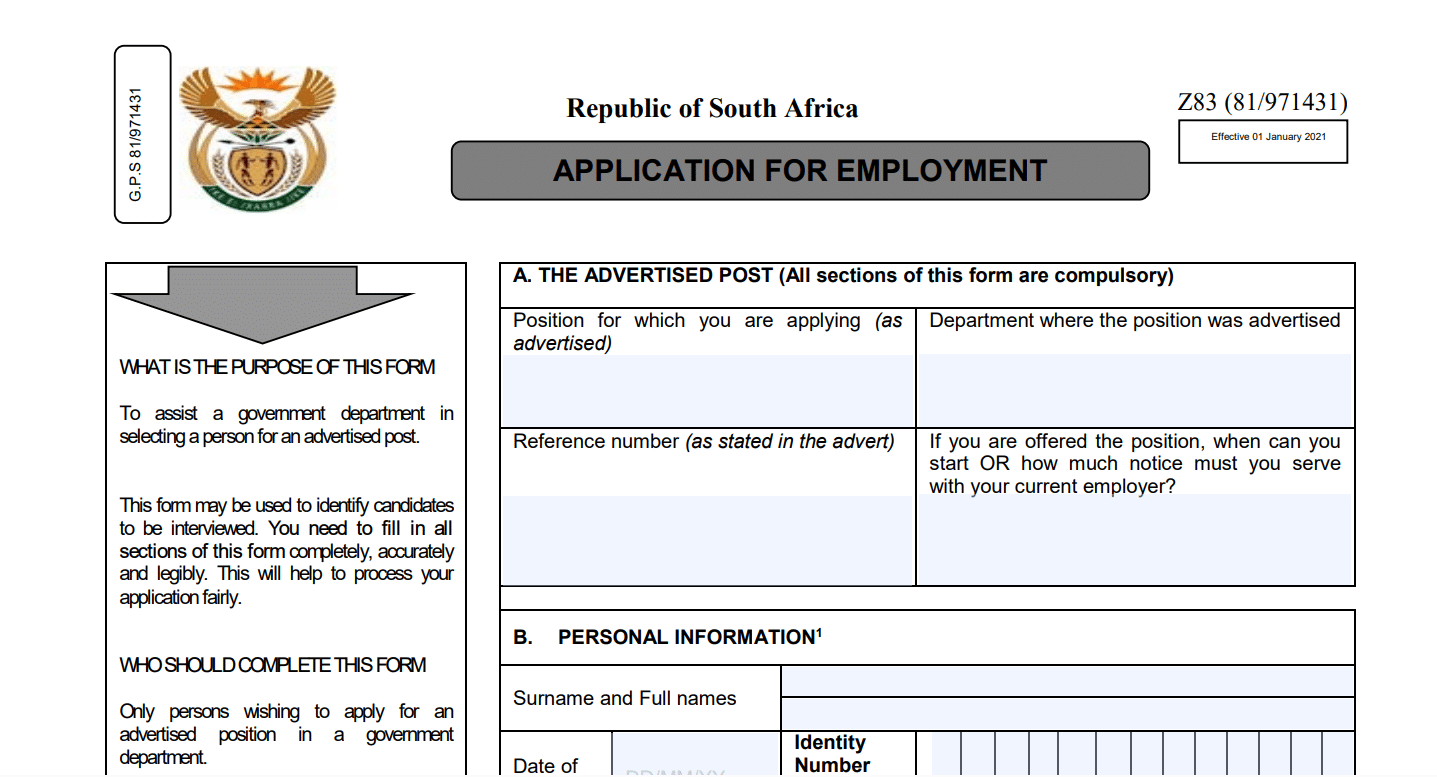
Applications must be submitted on the prescribed Z83 application form (obtainable from any Public Service Department or on the DPSA website link: https:/www.dpsa.gov.za/newsroom/psvc/, which must be signed, initialled and dated by the applicant, and must be accompanied by a detailed curriculum vitae (CV) only. Candidates are not required to submit certified copies of qualifications and related documents on application. Only shortlisted candidates will be required to submit certified copies of qualification and other
related documents on or before the date of interview, which should not be older than six months.

Should an application be submitted using incorrect/old Z83 application form, such an application will be disqualified. Further take note of the following on completion of Z83 application form: PART A and PART B must be fully completed. PART C – PART G: Noting that there is a limited space provided applicants may refer to CV or indicate. This will be acceptable as long as the CV has been attached and provides the required information. Page 1 of the Z83 application form must be initialled and page 2 signed and dated by the
applicant. Failure to comply with the above instructions may result in an application being disqualified.

Applicants applying for more than one advertised post must submit separate Z83 application forms and CVs in respect to each post being applied for. Should an application be received where an applicant has applied for more than one posts on the same Z83 application form, the applicant will be considered for the first post indicated on the Z83 application form only. Applications will be received via post/courier services, hand
deliveries or email. Late applications will not be considered. Regulation 57 (c) and 67 (9) of the Public Service Regulations 2016, as amended, requires the executive authority to ensure that he or she is fully satisfied of the claims being made and the finalisation of Personnel Suitability Checks in order to verify claims and check the candidate for purpose of being fit and proper for employment, respectively. Shortlisted candidates must be willing to undergo normal vetting and verification processes.

Note: It is the responsibility of all applicants to ensure that foreign qualifications are evaluated by SAQA. Due to large volume of responses anticipated, receipt of applications will not be acknowledged, and correspondence will be limited to shortlisted candidates only. Should you not have heard from us within three months from the closing date, please regard your application as unsuccessful. Entry level requirements
for SMS posts: in terms of the Directive on Human Resource Management and Development on Public Service Professionalisation Volume 1 a requirement for appointment into SMS posts is the successful completion of the Senior Management Pre-Entry programme as endorsed by the National School of
Governance (NSG). The course is available at the NSG under the name Certificate for entry into SMS and the full details can be obtained by following the below link: https: www.thensg.gov.za/training –course /sms-pre-entry programme/.

All shortlisted candidates, including the SMS, shall undertake two pre-entry assessments. One will be a practical exercise to determine a candidate’s suitability based on the post’s technical and generic requirements and the other must be an integrity (ethical conduct) assessment. Note: For emailed applications, please submit a SINGLE PDF document or ONE Attachment per application to the email address designated on the specific position. Kindly Note That The Emailed Applications And Attachments Should Not Exceed 15MB. It remains the candidate’s responsibility to ensure that their application is successfully submitted using the required single pdf document

HOW TO APPLY

Head Office (Pretoria) Applications: The Director-General, Department of Public Works and Infrastructure, Private Bag X65, Pretoria, 0001 or CGO Building, Corner Bosman and Madiba Street, Pretoria. For Attention Ms NP Mudau
Cape Town Regional Office Applications: The Regional Manager, Department of Public Works, Private Bag X9027, Cape Town, 8000. Or Hand Deliver at Ground floor, Customs House, Lower Heerengracht Street, Cape
Town. For Attention: Ms. C Rossouw

CLICK HERE to go to the DPSA jobs list and go to page 78 and page 74 for more information about this position.

Border Management Authority (BMA) is Looking for a Driver – Grade 12 and Code 10 Drivers License R172 583,94 – R210 102,19 Annual

Border Management Authority (BMA) is Looking for a Driver - Grade 12 and Code 10 Drivers License R172 583,94 - R210 102,19 Annual

Location: Centurion

Closing Date: 15 June 2026

The BMA is established as an armed service in terms of Section 199(3) of the constitution, a third in the country in addition to the South African National Defence Force (SANDF) and the South African Police Service (SAPS) through the Border Management Authority Act No 2 of 2020. The Border Management Authority invites suitable candidates to apply for the following vacant position.

Job Description: Border Management Authority (BMA) is Looking for a Driver

The successful candidates  will be expected to perform the following duties : Maintain accurate and up-to-date schedule trip sheets; i.e. log official trips, daily mileage, fuel consumption. Loading, transporting, and delivering items to clients or businesses in a safe, timely manner. Assisting with loading and unloading items from vehicles. Drive safely, obey the traffic laws, and respect the rights of other drivers. Transport staff. Complete all the required and prescribed records and logs books with regard to the vehicle and the goods handled. Ensure proper and secure control over movement of documents. Adhere to all relevant laws, policies and standard operating procedures throughout the Business.

Assist in ensuring a safe, hygienic and secure environment. Report any emergencies to the relevant to Manager/Supervisor as and when they occur. Take part in “in-service” training as required. Assist in identifying and adhering to fraud controls, risk prevention principles, sound governance and compliance processes, and tools to identify and manage risks. Perform daily trip and post trip vehicle inspection to ensure that the vehicle is in the best condition at all times. Report incidents and accidents timeously and compile vehicle condition reports and other records required by Management.

Coordinate and liaise with Facilities Management to ensure that minor/major vehicle maintenance are carried out. Ensure company standards are followed in welcoming and acknowledging all guests, Expect service needs of guests and provide them even before called upon to do so. Provide assistance to guests with disabilities. Genuinely appreciate and thank guests for their visit. Apply professional language in communicating with guests and other clients. 

ALSO CHECK: DPSA Circular 18 of 2026: Check the New List of South Africa Government Jobs from The Department of Public Service and Administration

Job Requirements

  • A Senior Certificate/ Grade 12 certificate (NQF 5) Code 10 drivers license
  • Valid PDP
  • Flexibility in working hours will be required to meet demands of the role.
  • May be required to work overtime.
  • Valid driver’s License.

The BMA is an equal opportunity employer committed to employment equity and workforce diversity preference may be given to suitably qualified candidates from designated groups in line with the BMA employment equity plan. The BMA reserves the right not to make an appointment to the advertised positions

Closing date: 15 June 2026

HOW TO APPLY

CLICK HERE TO APPLY

Earn R167 352 to R233 376 Per Annum as a Cleaner at The City of Ekurhuleni

Earn R167 352 to R233 376 Per Annum as a Cleaner at The City of Ekurhuleni
  • Location: City of Ekurhuleni
  • Closing Date: 10 June 2026

Minimum Requirements:

  • Grade 8
  • Multilingualism
  • Literacy
  • Attention to detail

Core Responsibilities:

  • Provide cleaning services within allocated office to ensure that the working environment is kept clean at all times
  • Make sure that own work is in line with work control and safety requirements
  • Be part of a culture that treats people well, builds relationships and keeps customers happy
  • Work well with coworkers and other parties in order to meet required work outputs and targets

Enquiries: Tel: 0860 54 3000. Candidates may be requested to submit proof of the NQF level applicable to the qualifications they have obtained.

About The City of Ekurhuleni

The City of Ekurhuleni is a major metropolitan municipality in Gauteng, South Africa, located just east of Johannesburg. Known as “Africa’s Workshop,” it is a vital industrial and logistical hub. The name Ekurhuleni is a Tsonga word meaning “Place of Peace”.

HOW TO APPLY

CLICK HERE TO APPLY

Work as a General Worker at Clover South Africa and Condensed Milk Tin Packaging Department

Work as a General Worker at Clover South Africa and Condensed Milk Tin Packaging Department

Location: KwaZulu-Natal

Closing Date: 04 June 2026

Job Summary: Work as a General Worker at Clover South Africa and Condensed Milk Tin Packaging Department

The purpose of this position is to perform general operational duties within the Condensed Milk Tin Packaging Department, including shrink-wrapping, sorting damaged products, loading, cleaning, and carrying out any other tasks required by the Production team to support safe, efficient, and effective production operations.

Requirements

  • Grade 12 or equivalent NQF4
  • Business English: Fluent
  • Work in extreme conditions
  • Work shifts/weekends/public holidays
  • Pass Readiness Assessments

Competencies

  • Acts with honesty and consistency.
  • Maintains high standards.
  • Must be a team player.
  • Commitment and motivation
  • Communicates effectively.
  • Duties and Responsibilities
  • Perform basic/general tasks.
  • Complete basic tasks according to Standard Operating Procedures
  • Handling products
  • Comply with Health and Safety regulations.
  • Maintain housekeeping standards.
  • Any ad-hoc tasks as required by management

About Clover South Africa

Clover South Africa is one of the country’s largest and most trusted dairy and fast-moving consumer goods (FMCG) companies. Founded as a small co-operative in KwaZulu-Natal in 1898, it has evolved into a massive household name that produces milk, yogurts, desserts, and beverages across South Africa and selected African markets.

HOW TO APPLY

CLICK HERE TO APPLY

Broke & Jobless in South Africa? Here’s How Young People Are Actually Making It Work

Broke & Jobless in South Africa? Here's How Young People Are Actually Making It Work

Being broke, jobless and unemployed in South Africa is not a nice place to be. It can make your confidence drop, your stress go up, and your whole life feel stuck while bills, family pressure, and the cost of living keep moving like nothing is wrong. But here is the truth many people do not say enough: being jobless does not mean you are powerless, and it does not mean your life has stopped.

A lot of young South Africans are not “waiting for a miracle.” They are finding ways to survive, stay useful, keep moving, and slowly build momentum again. Some are doing small hustle work. Some are learning skills. Some are volunteering. Some are using data wisely and turning their phones into tools, not distractions. Some are combining two or three small income streams just to keep going. None of it is glamorous, but it is real. And real is what matters when you need to eat, send transport money, or keep hope alive.

This article is for the young person sitting at home right now wondering what to do next. It is for the graduate with no job. The matriculant with no funds. The TVET student waiting for a chance. The young adult who keeps hearing “just apply” as if applying is the same as getting hired. Let’s talk honestly about what actually works in South Africa when you are unemployed and broke, and how young people are making it work without pretending life is easy.

How Young People Are Actually Making It Work

Below is how young people are actually making it in a tough environment.

First, accept the season without accepting defeat

One of the hardest parts of unemployment is how quickly it can mess with your mind. You start asking yourself whether you are lazy, unlucky, not smart enough, or simply forgotten by the world. That is a dangerous place to stay for too long because it drains energy you need for action.

The first move is not to act rich, and not to act broken either. It is to accept that you are in a tough season, then decide that the season will not waste you. That mindset shift matters. A young person who says, “I am unemployed, so I must do nothing,” stays stuck. A young person who says, “I am unemployed, so I need a plan,” starts moving.

In South Africa, where jobs are scarce and competition is high, you cannot afford to treat unemployment like a holiday. But you also should not treat yourself like a failure because you are not working yet. That balance is important. You need urgency, not shame.

Start with survival, not perfection

When people talk about making it, they sometimes jump straight to “start a business” as if everyone has capital, a laptop, and a support system. That is not the reality for most young people. The first goal is survival. Feed yourself. Reduce pressure. Keep your phone on. Stay reachable. Avoid debt where possible. Then build from there.

A lot of young South Africans are making it work by doing very practical things:

  • Selling airtime or data bundles.
  • Washing cars in the neighbourhood.
  • Braiding hair.
  • Doing nails or simple beauty services.
  • Helping with tutoring for primary or high school learners.
  • Assisting with events setup and cleanup.
  • Doing delivery work where possible.
  • Babysitting, pet sitting, or elder support.
  • Helping local spaza shops with stock packing or cleaning.
  • Taking on admin work for small businesses.

These are not “small” in the real sense. They are bridge jobs. They keep people afloat while bigger opportunities are being pursued. Many people who are doing well today started with something that looked ordinary on the outside.

Use the skills you already have

A lot of young people think they have nothing to offer because they do not have formal work experience. That is simply not true. You probably already have skills that can help someone else save time, make money, or solve a problem.

Maybe you are good with:

  • Social media.
  • Writing messages or captions.
  • Fixing phones.
  • Using Excel or Word.
  • Basic bookkeeping.
  • Cooking.
  • Design on Canva.
  • Photography.
  • Driving.
  • Customer service.
  • Organising events.
  • Teaching children.
  • Cleaning and organising.

These are useful. Very useful. The mistake many unemployed young people make is waiting until they have a certificate before they start using what they already know. In South Africa, small businesses are everywhere, and many of them need affordable help. A bakery, barber shop, salon, security company, clinic, or aftercare centre may not post a formal vacancy, but they often need someone reliable.

That means you should not only apply online. Walk into places. Introduce yourself. Ask respectfully if they need help. Leave a clean CV. Follow up. Many jobs in South Africa are never advertised properly. They move through people, referrals, and trust.

Turn your phone into a job tool

Too many young people use their phones only for entertainment when the same phone could help them survive. If you are unemployed, your phone should work for you.

Use it to:

  • Search for vacancies every day.
  • Join relevant WhatsApp or Facebook groups that share jobs.
  • Update your CV.
  • Send your CV by email or WhatsApp where appropriate.
  • Learn a new skill from free videos.
  • Create content for your hustle.
  • Advertise your services.
  • Follow companies you want to work for.
  • Save important contacts.

This is one of the most common ways young people are making it work right now. A young person with no money can still have access to opportunity if they know how to use a phone properly. The challenge is discipline. If you spend five hours scrolling and five minutes applying, the phone is using you instead of the other way around.

Learn while you wait

Waiting for work does not mean waiting with folded arms. It means using the time to become harder to ignore. In South Africa, employers love experience, but if you do not have it yet, learning can help you bridge the gap.

Some of the most practical things unemployed youth are doing include:

  • Free online computer courses.
  • Basic bookkeeping.
  • Excel and data entry.
  • Digital marketing.
  • Customer service training.
  • Teaching English or tutoring.
  • Coding basics.
  • First aid training.
  • Health and safety short courses.
  • Driving and logistics knowledge.
  • Trade-related learning for welding, plumbing, electrical work, or construction support.

A young person who spends three months learning Excel, email writing, and document handling becomes more employable than someone who just keeps saying there are no jobs. Skills open doors. Even if the first opportunity is small, it can lead to another one.

And do not underestimate short courses. In South Africa, a short course can help you get a foot in the door for admin work, call centres, retail support, learnerships, internships, and entry-level office roles.

Volunteer with purpose

Volunteering is one of the most overlooked survival strategies for unemployed youth. People think it means working for free and getting nothing back. That is short-sighted. If you volunteer carefully and strategically, you build experience, references, discipline, and visibility.

For example, a young person can volunteer at:

  • A local school.
  • A church office.
  • A youth programme.
  • A community clinic.
  • A library.
  • An NGO.
  • A sports club.
  • A small business in the area.

You may not get paid immediately, but you can get:

  • A reference letter.
  • A line on your CV.
  • Practical experience.
  • A network.
  • A chance to prove reliability.

In South Africa, many young people get their first break because someone saw them consistently showing up, helping, and learning. Employers trust people who have already shown commitment somewhere else.

Build a one-page hustle

If you are unemployed, do not wait for a whole business plan before starting something small. Start with a simple offer. One clear service. One small hustle. One thing people can understand quickly.

Examples:

  • “I offer CV writing and job application help.”
  • “I do house cleaning and deep cleaning.”
  • “I make birthday cakes and snacks.”
  • “I do data capturing for small businesses.”
  • “I help with social media posts for local shops.”
  • “I tutor Grade 4 to Grade 10 learners.”
  • “I do phone repairs and screen protection.”
  • “I braid hair or do basic beauty services.”

The reason this works is because people pay for clarity. If your service is too broad, people forget you. If it is simple and well explained, they can recommend you.

Do not wait for a logo, a full website, or a business bank account to start. Start with what you can do now. Use WhatsApp status, Facebook community groups, posters at taxis ranks, school noticeboards, or word of mouth. Young South Africans are making it work every day with very little, because they are learning to sell what they know.

Reduce pressure by lowering unnecessary spending

When money is tight, pride becomes expensive. Many young people are trying to look fine while life is not fine. That is a fast way to make unemployment even harder.

If you are broke, cut costs where you can:

  • Use data wisely.
  • Avoid unnecessary rides and take cheaper transport where possible.
  • Skip impulse spending.
  • Stop buying for image.
  • Share resources with trusted family members or friends where possible.
  • Plan food carefully.
  • Avoid debt for lifestyle things.

This is not about suffering for fun. It is about protecting your little money so it can stretch. A lot of young South Africans are making it work not because they are earning a lot, but because they are reducing waste. That discipline matters.

Use your community

In South Africa, community still matters. A lot. The person who gives you your first job may be your neighbour, auntie’s friend, church elder, former teacher, soccer coach, or friend of a cousin. That is not always how people want the world to work, but it is how opportunity often moves here.

So tell people what you are looking for. Be specific. Say:

  • “I am looking for admin work.”
  • “I can do sales.”
  • “I want a learnership.”
  • “I can help with cleaning.”
  • “I am open to delivery or retail work.”
  • “I need internship opportunities in finance.”

Do not just say “anything.” People help faster when they know exactly what you can do. And when someone gives you an opportunity, even a small one, take it seriously. One good impression can lead to another.

Protect your dignity while you hustle

There is something many young people do not hear enough: taking small work is not shameful. There is no shame in selling, helping, cleaning, tutoring, delivering, or assisting. Shame is sitting at home refusing to move because the work does not look impressive.

In South Africa, dignity is not found in the title. It is found in effort. A person who earns honestly, helps their family, and keeps building has more dignity than someone who waits for perfect work and does nothing.

That said, protect yourself from exploitation. If a job sounds too good, ask questions. If someone wants to pay you in “exposure” forever, be careful. If a company asks you to pay money to get hired, pause and verify. Young people are making it work best when they are hopeful but wise.

Keep your documents ready

A surprising number of opportunities are lost because people are not ready. Someone asks for your CV, ID copy, matric certificate, bank confirmation, or references, and you start scrambling.

Have a basic folder ready:

  • Clean CV.
  • ID copy.
  • Matric certificate or latest results.
  • Highest qualification.
  • Proof of address if needed.
  • Reference contacts.
  • Professional email address.
  • Scanned documents saved on your phone and in email.

Being ready makes you faster than many other applicants. In a competitive market, speed matters. Young people who keep their documents ready often move ahead because they can apply the same day an opportunity appears.

Do not wait for motivation

Motivation comes and goes. Discipline stays longer. If you are unemployed, you cannot always depend on feeling inspired. You need a routine.

Try this:

  • Wake up at a decent time.
  • Check opportunities.
  • Send applications.
  • Learn something.
  • Reach out to one contact.
  • Work on your hustle.
  • Review what you did that day.

Even two hours a day of serious effort can change your situation over time. A lot of young people who seem to be “making it work” are not doing magic. They simply stay consistent while others disappear.

Real life example of how it comes together

Think of a young person in South Africa who does not have a job yet but starts combining small moves. In the morning, they apply for jobs and learnerships. In the afternoon, they assist a neighbour with admin work or tutoring. In the evening, they use their phone to post their services and follow job pages. On weekends, they help at events or do a side hustle. They are not rich. But they are not frozen either.

That is how many young South Africans are surviving right now. Not through one big breakthrough, but through stacking small wins. One hour here. One contact there. One short course. One gig. One referral. One reference. One interview. One step forward.

That is what making it work often looks like.

Stay mentally strong

Unemployment can make you feel invisible. It can make you compare your life to people who seem ahead. It can make you question your future. That is why your mindset matters so much.

Stay away from people who mock your struggle. Stay close to people who keep you moving. Limit the conversations that drain your hope. Celebrate progress, even if it is small. Send five CVs. Learn one skill. Make one sale. Get one reference. Those small wins matter.

You are not behind forever. You are in a hard season. There is a difference.

A final word to South African youths

If you are broke and jobless right now, I want you to hear this clearly: your life is not over, and your value is not determined by your employment status. South Africa is hard, yes. The economy is tough, yes. But young people are still finding ways to survive, learn, and grow through hustle, skill, patience, and grit.

You may not have the job you want yet, but you can still build momentum. Start where you are. Use what you have. Stay visible. Stay useful. Stay ready. Keep moving even when it is small.

And for more job opportunities, learnerships, internships, bursaries, and other youth opportunities in South Africa, follow Careers South Africa at https://www.careerssouthafrica.co.za/ — your plug for real opportunities that can help you move forward. Help a friend by sharing this. You will never be jobless!

Get Daily Job Opportunities To Your Inbox!

Follow us on our Social Media Handles to remain connected to daily opportunities:

Facebook: https://www.facebook.com/careerssouthafrica/

Linkedin: https://www.linkedin.com/company/careers-south-africa-za/

WhatsApp Group: https://chat.whatsapp.com/JVphaaPQEOU9VBlpVJAtIi?mode=gi_t

Nine CV Mistakes Costing You Job Interviews in South Africa – Check And Correct

Nine CV Mistakes Costing You Job Interviews in South Africa

By Blessing Khumalo, Recruiter and Consultant.

Let me say this plainly: in South Africa, a lot of good people are not struggling because they are unemployable. They are struggling because their CVs are not doing them justice due to numerous CV mistakes. I have seen brilliant young people from Soweto, Tembisa, Umlazi, Mthatha, Polokwane, and Kimberley miss interview after interview, not because they lacked potential, but because their CVs sent the wrong message before anyone even picked up the phone.

That part hurts, because a CV is often your first chance to speak for yourself. In a tough job market like ours, where one vacancy can attract hundreds of applications, your CV must be clean, focused, and professional. It must make a recruiter think, “This person is worth meeting.” It should not make the recruiter stop reading after the first page.

Avoid blaming the rising unemployement by being proactive to this CV mistakes problem. So let’s talk honestly about the nine CV mistakes that cost South African job seekers interviews every single day, and more importantly, how to fix them. I’m writing this like I would tell a young job seeker sitting across from me in an interview prep session, because too many people are losing chances they should have had.

Nine CV Mistakes Costing You Job Interviews in South Africa

1. Using a CV That Looks Messy and Unprofessional

The first mistake is simple, but it is one of the biggest: the CV looks messy. Bad spacing, different fonts, weird colours, too many borders, clipart, photo filters, and pages that look like they were put together in a rush. In South Africa, where many recruiters scan a CV in less than a minute, presentation matters.

A recruiter should not need to struggle to find your name, contact number, education, and work experience. If the CV is visually confusing, the recruiter already starts doubting how carefully you work. I once saw a young applicant from Pretoria with strong matric marks and internship experience, but the CV had six different font styles and a bright green background. It was hard to read, and unfortunately, it went straight into the no pile.

How to avoid having a CV that looks messy and unprofessional:

  • Use a clean, simple layout.
  • Stick to one or two fonts only.
  • Keep the design neat and professional.
  • Make sure your name and contact details stand out clearly.
  • Use black text on a white background unless the employer asks for something else.

A good CV should look like you respect the reader’s time. That matters more than trying to make it fancy.

2. Making the CV Too Long

Another big mistake is writing a CV that is way too long, especially for entry-level jobs. I know many young people feel they must include everything they have ever done, from matric class captain to helping at a cousin’s tuck shop. But recruiters are not looking for a life story or a bible of some sort. They are looking for evidence that you can do the job.

If you are early in your career, one to two pages is usually enough – but try to have everything on one page, especially if you have less than 3 years experience. A CV that runs to five or six pages often tells me one of two things: either the person is unsure what matters, or they are trying to hide weak points with volume. Neither helps.

I remember interviewing a candidate from Durban who had a four-page CV for a junior admin role. Half of it was repeated information, and the important parts were buried. She had good computer skills and a short office internship, but I had to work too hard to find that. A shorter, sharper CV would have helped her.

How to avoid having a very long CV:

  • Keep it concise.
  • Cut out unrelated details.
  • Focus on the experience that matches the job.
  • Summarise older or less relevant roles.
  • Remove repetition.

A CV is not a memorial service. It is a marketing document, which is sharp and precise.

3. Writing a Generic CV for Every Job

This one is very common. A young person sends the same CV to every company, whether they are applying for a learnership, cashier position, admin role, call centre job, or office assistant post. That approach rarely works. South African employers want to see that you understand the role.

If you apply for a sales role, your CV should highlight customer service, communication, and targets. If you apply for a learnership, your CV should highlight your education, willingness to learn, and any practical exposure. If you apply for a driving or logistics role, then your licence, route knowledge, and reliability matter more.

I have seen graduates in Johannesburg with good qualifications but no interviews because their CVs read like a random list of facts. It looked like the same CV had been fired off to 40 employers without even a small adjustment. Recruiters notice that.

How to avoid having a generic CV for every job:

  • Tailor the CV to each role.
  • Match your skills to the job description.
  • Reorder your experience so the most relevant parts come first.
  • Change your career summary for different roles.
  • Use the same core CV, but adapt the content.

That small effort can make the difference between being ignored and being shortlisted.

4. Leaving Out Contact Details or Using Unreliable Ones

This one sounds basic, but it happens all the time. A person applies with no email address, no proper phone number, or a number that does not work. Some people use an email address that is childish or unprofessional, and then wonder why no one responds.

I once reviewed a pile of CVs for an internship in Cape Town. One candidate had strong qualifications, but the phone number on the CV was missing one digit. Another had an email address that sounded like something from high school days. The company tried contacting them and could not get through. That interview never happened.

How to avoid having unreliable contact details on your CV:

  • Include a working phone number.
  • Add a professional email address.
  • Make sure your voicemail message sounds decent.
  • Check that the number you give is the one you actually answer.
  • Keep your contact details at the top of the CV.

If a recruiter cannot reach you, your CV is useless, no matter how strong it is.

5. Spelling Mistakes and Poor Grammar

A CV with spelling mistakes, bad grammar, and careless sentence structure is one of the fastest ways to lose credibility. This does not mean you must sound like a lawyer or write in big English words. It means your application must show care, attention, and basic communication ability.

In South Africa, where many jobs require teamwork, email communication, customer interaction, and written reporting, grammar matters. If you are applying for an office role and your CV says “Responsible for assisitng in the daily taskes,” that is a problem. Small errors can make a recruiter think, “If they could not proofread this, what else did they not check?”

I once saw a CV from a candidate in Rustenburg who had excellent experience in retail, but the document was full of spelling errors. The person may have been capable, but the CV did not reflect that capability.

How to avoid spelling mistakes and poor grammar on your CV

  • Read the CV slowly before sending.
  • Use spell check.
  • Ask someone else to review it.
  • Keep sentences short and clear.
  • Do not rely only on autocorrect.

A clean CV tells the employer that you are careful. Careless CVs get treated like careless workers.

6. Listing Duties Instead of Achievements

Many job seekers write what they did, but not what they achieved. There is a difference. Saying “I worked as a cashier” is not enough. Saying “Handled cash transactions, balanced tills, and served an average of 100 customers per shift” gives the recruiter a much clearer picture.

In South Africa, employers are not only interested in job titles. They want proof of value. Even if you have limited work experience, you can still show impact. Maybe you helped reduce mistakes in stock counts, improved filing, assisted with customer queries, or contributed to a smoother office routine.

A young person from Alexandra once showed me a CV that said she “worked at a spaza shop.” That was all. But when we dug deeper, we found she handled sales, tracked stock, managed customer payments, and helped with suppliers. That was much stronger than the original wording.

How to avoid listing duties instead of achievements on your CV:

  • Turn duties into results where possible.
  • Use action words like handled, supported, improved, assisted, coordinated, resolved.
  • Add numbers if you have them.
  • Show impact, not just tasks.
  • Think about what changed because you were there.

Achievements make a CV come alive.

7. Hiding Gaps or Leaving Out Important Information

Some people think if they ignore a gap in employment, no one will notice. But recruiters do notice. If you have been unemployed for a while, do not panic. Just be honest and smart about how you present your story.

Maybe you were looking for work, doing informal work, studying part-time, helping at home, or volunteering. That can still be explained. What is risky is leaving large blank spaces with no explanation at all, because the recruiter may think you are hiding something.

I have seen candidates from many parts of the country who had gaps but were honest. One young man from East London had been unemployed for a year, but during that time he did computer short courses and helped his uncle with delivery work. That was a better story than pretending nothing happened.

How to avoid leaving out important information on CV:

  • Be honest about gaps.
  • Include short courses, volunteering, and informal work.
  • Use a simple career summary if needed.
  • Do not lie about dates.
  • If you were unemployed, say so confidently and move on.

A gap is not always a deal-breaker. Silence and confusion are worse.

8. Ignoring Skills That South African Employers Actually Want

A CV can be full of information and still miss the point. Why? Because the skills listed are vague or outdated. Saying “I am a hard worker” is nice, but it is not enough. Employers want practical skills. They want to know whether you can use Excel, answer phones, write emails, work under pressure, handle customers, drive, sell, file, operate machinery, or use basic digital tools.

In South Africa, many entry-level jobs now require some level of computer literacy. Even smaller businesses often want staff who can use WhatsApp professionally, email documents, scan papers, or update spreadsheets. Yet I still see CVs from young applicants that do not mention any real skills beyond “good communication” and “team player.”

That is too weak.

How to avoid ignoring CV Skills that employers actually want:

  • List practical skills clearly.
  • Include computer skills, customer service, admin skills, or technical skills.
  • Only mention what you can actually do.
  • Match your skills to the job.
  • Be specific, not vague.

For example:

  • Microsoft Word.
  • Microsoft Excel.
  • Data capturing.
  • Stock taking.
  • Telephone etiquette.
  • Customer service.
  • Basic bookkeeping.
  • Driving licence code.

That kind of list helps a recruiter quickly see where you fit.

9. Forgetting That the CV Must Match the Job Level

This is the mistake many young people do not see. They apply for a junior role with a CV that sounds like a senior manager, or they apply for a professional role with a CV that is too basic. The tone, structure, and content must match the level of the job.

If you are a matriculant applying for a learnership, your CV should reflect education, motivation, discipline, and any school or community involvement. If you are a graduate applying for a finance internship, your academic record, computer skills, and relevant projects matter more. If you are applying for an artisan role, trade exposure and practical work should come first.

I once met a young candidate from Bloemfontein who had a strong CV, but it was written like he was already the branch manager. For a first job, that made him sound unrealistic. On the other hand, some graduates undersell themselves and forget to mention projects, presentations, or campus leadership that would actually strengthen their profile.

How to make a CV match the required job level:

  • Write for the role you want.
  • Use the correct level of language.
  • Do not exaggerate.
  • Do not undersell yourself either.
  • Present your strengths in a way that fits the vacancy.

The CV should feel like a proper fit, not a forced one.

What a Strong South African CV Should Do

A strong CV does not need to be fancy. It needs to be clear, honest, and relevant. It should help the employer understand three things quickly:

  • Who you are.
  • What you can do.
  • Why you are worth interviewing.

That is the heart of it. In a market like South Africa, where competition is tough and opportunities are limited, small mistakes can cost people interviews they really needed. But the good news is that most CV mistakes are fixable. You do not need money to improve your CV. You need care, honesty, and a little guidance.

I always tell young job seekers this: your CV is not just paper. It is your first handshake. It is your first sentence. It is your first chance to show discipline, effort, and potential before anyone meets you in person.

A Word to South African Youth

If you are young and job-hunting in South Africa right now, do not let rejection make you feel small. Sometimes the problem is not that you are not good enough. Sometimes the problem is that your CV is not telling your story properly yet. That can be changed.

Sit down and rebuild it carefully. Remove what does not matter. Strengthen what does. Ask someone older and experienced to look at it. Compare it with the role you are applying for. Keep improving. The young people who get ahead are not always the smartest in the room. Often, they are the ones who keep refining their approach until opportunity finally notices them.

And when you are ready to look for more jobs, learnerships, internships, and youth opportunities in South Africa, make sure you follow Careers South Africa at https://www.careerssouthafrica.co.za/ as your plug for opportunities that can help you move forward.

Get Daily Job Opportunities To Your Inbox!

Follow us on our Social Media Handles to remain connected to daily opportunities:

Facebook: https://www.facebook.com/careerssouthafrica/

Linkedin: https://www.linkedin.com/company/careers-south-africa-za/

WhatsApp Group: https://chat.whatsapp.com/JVphaaPQEOU9VBlpVJAtIi?mode=gi_t

City of Tshwane is Looking for Two(2) General Workers to Earn R242 666,00 – R278 193,00 Per Annum

City of Tshwane is Looking for Two(2) General Workers to Earn R242 666,00 – R278 193,00 Per Annum
  • Location: Bronkhorstspruit, Bronkhorstspruit, ZA, Bronkhorst
  • Company: City of Tshwane
  • Scale: R165 564,00 – R193 476,00 per annum
  • Estimated remuneration package: R242 666,00 – R278 193,00 per annum

Job purpose: City of Tshwane is Looking for Two(2) General Workers

To conduct general maintenance work in developed and undeveloped open spaces and at natural resources and facilities to improve the quality of the environment

ALSO CHECK: Four(4) Legal Internships at The Office of the Pension Funds Adjudicator (OPFA) – 24 Months Training Programme

General Worker Appointment Requirements

  • Ability to perform duties
  • Basic literacy
  • Relevant knowledge and experience in horticultural maintenance will be an added advantage
  • Physical fitness and health with no back problems
  • Must undergo a criminal record check and such a person shall allow their fingerprints to be taken by the Tshwane Metro Police Department at own cost
  • Willingness and ability to work shifts, standby and overtime on request

Personal attributes and/or competencies

Physical health, fitness and a strong physique; willingness to accept responsibility; ability to implement and uphold routine; ability to pay attention to detail; good communication skills; good interpersonal skills; ability to show initiative; flexibility and adaptability; ability to work under pressure; being self-motivated; being hard-working; being punctual, responsible, accountable and reliable; having a basic understanding of pool maintenance

Primary functions

  • Conduct general horticultural maintenance in public open spaces and at horticultural facilities and depots
  • Clean parks and traffic islands
  • Clean open spaces in remote areas
  • Cut and remove invaders and alien plant material
  • Remove weeds
  • Pick up litter
  • HOW TO APPLY

CLICK HERE TO APPLY