
How to Write a Bursary Motivational Letter That Makes the Selection Panel Notice You

How to Write a Bursary Motivational Letter That Makes the Selection Panel Notice You

Bursary Motivational Letter

How to Write a Bursary Motivational Letter That Makes the Selection Panel Notice You

Writing a bursary motivational letter can feel intimidating. You may be sitting at the kitchen table, looking at a blank page, wondering how to explain your dreams, your financial situation, and your academic journey without sounding desperate or repeating what is already on your application form. The truth is that a strong letter does not require complicated English or dramatic storytelling. It requires honesty, structure, and a clear explanation of why supporting you would be a worthwhile investment.

Every year, many South African students apply for bursaries. Some are high-achieving learners from rural schools. Others are university students struggling to remain registered because of unpaid fees. Some are the first people in their families to attend university or college. Their circumstances may be different, but they all face the same challenge: they must convince a selection panel that they are serious, capable, and deserving of financial support.

Your letter gives the panel something that marks and documents cannot always provide. It allows them to see the person behind the percentages. It explains what motivates you, what you have overcome, what you hope to achieve, and how the bursary could change your future.

What the selection panel is really looking for

Before you start writing, it helps to understand what happens on the other side of the application. A bursary selection panel is usually not asking, “Can this applicant write impressive sentences?” They are asking practical questions:

  • Does this student meet the basic requirements?
  • Is the student genuinely committed to the proposed field of study?
  • Is there a real financial need?
  • Has the student shown discipline and potential?
  • Does the student’s goal align with the organisation’s purpose?
  • Will the student use the opportunity responsibly?
  • Has the applicant followed the instructions properly?

Your letter should answer these questions naturally. You do not need to write the questions and then respond to them one by one. Instead, organise your story so that the answers become clear.

For example, saying, “I am hardworking and passionate” is not very convincing on its own. Showing that you maintained strong marks while caring for younger siblings, volunteering at school, or travelling a long distance to attend classes is much more powerful. Evidence gives your words weight.

Start with a proper structure

A well-written letter should be easy to read. Do not make the panel search through a wall of text to find your main point.

A simple structure works well:

  1. Your contact details and the date.
  2. The name of the organisation or bursary programme.
  3. A respectful greeting.
  4. A short introduction.
  5. Your academic background and chosen course.
  6. Your financial circumstances.
  7. Your personal qualities and achievements.
  8. Your career goals.
  9. Why you are applying to that particular bursary.
  10. A professional closing.

Usually, one to two pages is enough, unless the bursary provider gives different instructions. A focused letter is stronger than a long letter filled with repetition. Many writing guides recommend keeping a bursary motivation within roughly 400 to 800 words, depending on the provider’s requirements.dailyfeed.co+1

Use a readable font, clear paragraphs, and consistent spacing. Save the document as a PDF if the application instructions request one.

Open with purpose, not drama

Your first paragraph should immediately explain who you are and why you are writing. Avoid beginning with a long emotional story before the reader knows what the application is about.

A clear opening might look like this:

My name is Lerato Mokoena, and I am a Grade 12 learner at Mohloli High School in Limpopo. I am applying for the 2027 [Organisation Name] Bursary to study BSc in Computer Science at the University of Pretoria. I am passionate about using technology to improve access to services in rural communities, and I believe this opportunity would help me develop the skills to pursue that goal.

This introduction works because it gives the panel essential information immediately:

  • Your name.
  • Your current educational position.
  • The bursary you want.
  • The course you plan to study.
  • Your broader motivation.

Do not start with, “I have always wanted to be successful.” That may be true, but it is too general. Start with information that helps the panel understand your application.

Tell your academic story honestly

Your marks matter, but the panel may want to know more than your average. Explain which subjects relate to your intended course and mention meaningful achievements.

For example:

I achieved an overall average of 76% in Grade 11, including 82% in Mathematics and 79% in Physical Sciences. I also received a certificate for academic improvement after raising my Mathematics mark from 61% to 82% within one year. This improvement taught me that consistent effort can produce results, even when a subject initially feels difficult.

This is stronger than simply writing, “I am an excellent student.” It provides measurable evidence and shows perseverance.

If your marks are not perfect, do not lie or try to hide them. Many students have experienced difficult periods. Perhaps you changed schools, lost a parent, became responsible for younger siblings, experienced illness, or struggled with a particular subject. You can explain this briefly without turning the entire letter into an excuse.

For example:

My Grade 11 results were affected by the passing of my grandmother, who was my primary caregiver. Although that period was difficult, I sought academic support and improved my results in Grade 12. I am proud of the progress I made and remain committed to my studies.

This shows honesty, resilience, and accountability.

Explain your financial need with dignity

Financial need is often central to a bursary application, but many applicants are unsure how much personal information to share. The best approach is to be factual, respectful, and specific.

You might explain:

  • Who supports the household.
  • Whether a parent or guardian is unemployed.
  • The number of people who depend on the household income.
  • Whether you receive support from relatives.
  • Why tuition, accommodation, transport, books, or meals are difficult to afford.
  • Any circumstances that have affected your family’s finances.

For example:

I come from a household of six people. My mother is the sole breadwinner and works as a domestic worker, while my father is currently unemployed. My two younger siblings are still in school. Although my family supports my education emotionally, our household income is not sufficient to cover university tuition, accommodation, textbooks, and transport.

This is clear and dignified. It does not exaggerate your situation, and it gives the panel enough context to understand your need.

Avoid making claims that cannot be supported by your documents. If the application requires proof of income, affidavits, or other financial information, ensure that your letter is consistent with those documents.

Connect your course to a real career goal

A panel wants to see that you have thought carefully about your studies. You do not need to have your entire life planned, but you should be able to explain why you chose your course and where you hope it will take you.

Weak example:

I want to study engineering because it is a good career.

Stronger example:

I want to study Civil Engineering because I have become interested in how infrastructure affects the quality of life in rural communities. In my area, poor roads and unreliable water systems affect learners, businesses, and access to healthcare. My long-term goal is to work on infrastructure projects that improve service delivery in under-resourced communities.

The second example is more convincing because it connects the course to a real observation and a meaningful goal.

You can also describe an experience that influenced your choice. Perhaps you helped repair computers at school, shadowed a nurse, participated in a robotics competition, or became interested in farming after working on your family’s land. Personal experiences make your motivation believable.

Research the bursary provider

One of the easiest ways to make your letter stronger is to understand the organisation offering the bursary. Do not send the same generic letter to every company.

Find out:

  • What fields of study the bursary supports.
  • Whether the organisation prioritises particular provinces or communities.
  • Whether it offers vacation work or employment after graduation.
  • What values or community programmes it promotes.
  • Whether it focuses on scarce skills or a specific industry.

Then explain how your goals connect to its work.

For example, if a mining company supports students studying mining engineering, geology, environmental science, or metallurgy, explain your interest in the industry and responsible resource development. If a bank funds accounting, information technology, economics, or actuarial science, show how your interests fit within financial services.

A tailored paragraph could say:

I am particularly interested in the [Company Name] Bursary because of the organisation’s investment in developing scarce skills and supporting young people from communities near its operations. My goal of becoming an environmental scientist aligns with the need for responsible environmental management in South Africa’s mining sector.

That sounds far more thoughtful than, “I am applying because I need money.”

Show character through examples

Personal qualities are important, but do not simply list adjectives. Anyone can write, “I am hardworking, dedicated, reliable, and passionate.” The panel has seen those words many times.

Instead, show the quality through an example.

For instance:

I developed my leadership skills by serving as the chairperson of our school’s reading club. We organised weekly reading sessions for Grade 8 learners and collected donated books for the school library. This experience taught me how to organise people, communicate clearly, and remain committed to a project even when participation was initially low.

This paragraph demonstrates leadership, communication, initiative, and community involvement without naming every quality directly.

Other experiences you can mention include:

  • Tutoring classmates.
  • Helping with a family business.
  • Volunteering at a local organisation.
  • Playing sport or participating in cultural activities.
  • Serving on a student committee.
  • Organising a fundraising event.
  • Completing a short course.
  • Caring for family members while studying.
  • Working part-time or during holidays.

Your experience does not need to be extraordinary. What matters is what you learned and how it shaped you.

Write about your community

Many bursary providers want to support students who will contribute to society. This does not mean you must promise to solve every problem in South Africa. It means you should explain how your education may benefit others.

A good example might be:

After completing my qualification, I hope to return to my province and work in public healthcare. I would also like to mentor learners who are interested in science but lack access to career guidance. My own journey has shown me how important encouragement and information can be.

That is realistic and personal. You are not promising something impossible. You are showing that your ambition extends beyond personal income.

If you come from a rural or township community, you can mention the challenges you have observed, but avoid presenting your community only as a place of hardship. Talk about its strengths as well: resilience, creativity, close relationships, entrepreneurship, or cultural richness.

Be careful with emotional language

A motivational letter should be personal, but it should not manipulate the reader. There is a difference between explaining hardship and using exaggerated language to create pity.

Avoid writing:

If I do not receive this bursary, my entire life will be destroyed and I will never succeed.

A more balanced version would be:

Receiving this bursary would remove a significant financial barrier and allow me to focus more fully on my studies. Without support, my family may struggle to cover the full cost of tuition and accommodation, which could affect my ability to register and remain at university.

The second version is serious but controlled. It communicates the consequences without making an absolute claim.

You should also avoid comparing yourself negatively with other applicants. Do not say, “I deserve this more than everyone else.” Focus on your own circumstances, effort, and potential.

Use plain English

You do not need to use big words to sound intelligent. In fact, complicated language can make your writing seem unnatural or unclear.

Instead of:

I am profoundly desirous of being considered for the aforementioned educational financial intervention due to my unwavering aspiration to attain academic excellence.

Write:

I would be grateful to be considered for this bursary because it would help me continue my studies and work towards my career goals.

Simple writing is often more powerful because the reader understands it immediately.

Read your letter aloud after writing it. If a sentence sounds like something you would never say, rewrite it in your own voice. The goal is to sound professional, not artificial.

Avoid repeating your CV

Your letter should complement your application, not copy it. If your CV already lists every subject and activity, use the letter to explain the meaning behind selected experiences.

For example, rather than listing “Volunteer tutor, 2025,” write:

In 2025, I volunteered as a Mathematics tutor for Grade 10 learners. The experience strengthened my own understanding of the subject and showed me how much confidence a learner can gain from patient support.

That gives the panel insight that a CV cannot provide.

Choose two or three relevant experiences and explain what they taught you. You do not need to mention every activity you have ever participated in.

A complete example

Below is a fictional example of how the parts can come together.

Dear Bursary Selection Committee,

My name is Nandi Dlamini, and I am currently completing my first year of a Bachelor of Education degree at the University of KwaZulu-Natal. I am applying for the [Organisation Name] Bursary because I require financial support to continue my studies and achieve my goal of becoming a Mathematics teacher.

I became interested in teaching after helping learners at my former high school with Mathematics during afternoon study sessions. Many of the learners understood the work but lacked confidence and individual support. This experience showed me that a patient teacher can make a lasting difference in a learner’s life. I therefore chose education because I want to help improve Mathematics performance in schools, particularly in communities where learners have limited access to extra lessons.

My academic record reflects my commitment to this goal. I achieved 78% in Mathematics in Grade 12 and received recognition for consistent improvement in Physical Sciences. At university, I have maintained good attendance and participate in a student tutoring programme. Through this programme, I assist first-year students with basic Mathematics and study planning.

My family is unable to cover the full cost of my studies. My mother is unemployed, and my grandmother supports our household through an old-age grant. I have two younger siblings who are still attending school. Although my family encourages me to continue with my education, tuition, accommodation, transport, and textbooks are beyond what we can afford.

I am applying to your organisation because of its commitment to supporting education and developing young South Africans. If selected, I will use the opportunity responsibly and remain focused on completing my degree. After graduating, I hope to teach Mathematics in a rural school and support learners who may otherwise believe that university is beyond their reach.

Thank you for considering my application. I would be honoured to receive your support and will work hard to justify your investment in my education.

Yours sincerely,
Nandi Dlamini

Notice that the letter is not full of dramatic phrases. It is clear, personal, and specific. It explains her academic interest, financial need, experience, and future plans.

Common mistakes that weaken applications

Sending the same letter everywhere

A generic letter suggests that you have not researched the provider. Change the organisation’s name, course details, and alignment paragraph for each application.

Writing only about financial hardship

Financial need is important, but the panel also wants to know what you are studying, what you have achieved, and what you hope to do. Balance need with potential.

Making unsupported claims

Do not say you are the top learner in your province unless you can prove it. Avoid inventing leadership positions or exaggerating family circumstances.

Forgetting the course name

Always state what you are studying or intend to study. If you are applying for a specific field, make that connection clear.

Ignoring the instructions

If the provider asks for a specific subject line, word count, document format, or question, follow it exactly. A beautiful letter cannot correct an application that does not meet basic requirements.

Submitting an unproofread document

Spelling mistakes, incorrect names, and poor formatting create an unnecessary negative impression. Ask someone you trust to read your letter before sending it.

Using the wrong organisation name

This happens when applicants reuse templates. It can immediately show the panel that the letter was copied. Check the name, date, course, and pronouns before submitting.

A final checklist before you submit

Ask yourself:

  • Did I name the correct bursary provider?
  • Did I clearly state what I am studying?
  • Did I explain why I chose this course?
  • Did I provide honest information about my financial situation?
  • Did I include specific examples of effort, leadership, or community involvement?
  • Did I connect my goals to the provider’s mission?
  • Did I avoid repeating my entire CV?
  • Is the letter within the requested word limit?
  • Is the grammar and spelling correct?
  • Did I attach every required document?
  • Did I save the file in the requested format?
  • Did I use the correct email address or online application portal?

If the answer to all of these is yes, your application is in a much stronger position.

Your next opportunity may be closer than you think

A bursary can do more than pay university fees. It can give a young person the freedom to focus on studies, access to accommodation and learning materials, and the confidence that someone believes in their potential. But funding opportunities are competitive, so preparation matters.

Take time to write a letter that sounds like you. Be honest about where you come from, proud of what you have achieved, and clear about where you are going. Do not apologise for needing help. A bursary exists to support students who have potential but face financial barriers.

If you are also looking for internships, learnerships, scholarships, apprenticeships, online courses, or entry-level jobs, visit Careers South Africa. The platform brings together opportunities for South African youth, including bursaries, training programmes, jobs, and career guidance, with updates added regularly. Follow the site and its social channels for daily job updates and practical job tips that can help you move from applying for funding to building the career you want.

A strong bursary motivational letter will not guarantee success, but it can help the selection panel see your potential clearly. Write with honesty, prepare carefully, and keep applying – even when the first answer is no.

How to Write a Bursary Motivational Letter That Actually Gets Read in South Africa

Department of Forestry, Fisheries and the Environment (DFFE) Bursary Programme 2027

Department of Forestry, Fisheries and the Environment (DFFE) Bursary Programme 2027

Department of Forestry, Fisheries and the Environment (DFFE) Bursary Programme 2027

The Department of Forestry, Fisheries and the Environment (DFFE) has opened its Full-Time Bursary Programme for the 2027 academic year, and for young South Africans wanting to study toward a career in conservation, environmental management, fisheries, or related sciences without the financial strain of tuition, this government-funded route is well worth serious consideration.

  • Closing Date: 2 October 2026
  • Location: Applicable to full-time students at recognised South African institutions of higher learning nationwide, or Grade 12 (Matric) learners planning to study further; the bursary is administered from the DFFE’s Pretoria head office
  • Bursary Amount: Maximum of R80,000.00

DFFE Bursary Overview

The DFFE Bursary Programme exists to build the next generation of skilled professionals in South Africa’s environmental, forestry, and fisheries sectors. It’s open to two distinct groups of applicants: full-time students already registered at a recognised institution of higher learning, and Grade 12 (Matric) learners who are not currently employed and are planning to study further. Bursaries are strictly reserved for these two categories, meaning working professionals or part-time students generally won’t qualify.

Because the DFFE runs this programme year after year with clearly defined fields of study tied to reference numbers, it’s a genuinely structured and predictable funding opportunity, rather than a vague or informal offering.

Fields of Study Typically Covered

While applicants should always confirm the exact list against the current advert, the DFFE’s bursary programme has consistently funded studies across categories including:

  • Biodiversity and Conservation (covering qualifications such as Environmental Management, Environmental Science, Biological Science, and Natural Sciences Management)
  • Chemicals and Waste Management
  • Climate Change, Air Quality and Sustainable Development
  • Environmental Programmes
  • Fisheries and Marine Sciences (covering Oceanography, Marine Biology, Ichthyology, Aquaculture, and Aquatic Science)
  • Forestry Science, Wood Technology, and Nature Conservation
  • Spatial Planning, GIS and Remote Sensing, and Environmental Informatics
  • Environmental Law, Environmental Education, and Environmental Health
  • Environmental Economics, Fisheries Economics, and Development Finance

This breadth means the bursary genuinely accommodates students across a wide range of science, law, and economics-related disciplines, provided the specific qualification ties back to the environment, forestry, or fisheries mandate.

Requirements and Eligibility Criteria

To be eligible for this bursary, applicants must meet the following criteria:

  • Be a full-time student enrolled at a recognised institution of higher learning, or an individual currently in Grade 12 (Matric)
  • Not be employed
  • Never have previously participated in the Public Service Internship Programme
  • Understand that, upon completion of studies, participation in the DFFE’s internship programme becomes mandatory as part of the bursary contract agreement
  • Accept that regulations prohibit participating in the internship programme more than once
  • Apply using the prescribed bursary application form only, with the correct reference number and study field clearly indicated

Applications submitted by fax or email will not be accepted, and incomplete applications will not be considered, so it’s worth taking real care over the paperwork before submitting.

Required Supporting Documents

Every application must be accompanied by the following, all properly certified where applicable:

  • A motivation letter explaining why the bursary should be awarded to you
  • Certified copies of qualifications and recent academic records
  • Certified copies of identity documents, for both the applicant and both parents or guardians
  • Proof of registration, if already enrolled at an institution of higher learning
  • Latest Grade 12 results, if currently in high school
  • Proof of parents’ or guardian’s income
  • A death certificate, if a parent is deceased
  • An affidavit, if a parent is not working

Skills and Attributes That Strengthen an Application

While the DFFE’s criteria are largely document-based, applicants who present themselves strongly for this bursary generally show:

  • A clear, genuine motivation tied to environmental, forestry, or fisheries-related career goals, rather than a generic funding request
  • Strong academic performance, particularly in Mathematics and Science subjects relevant to the chosen field
  • Careful attention to detail when completing the prescribed application form and gathering supporting documents
  • A well-considered choice of study field, correctly matched to the relevant reference number on the application form
  • Genuine understanding of how the chosen qualification connects to South Africa’s broader environmental and conservation challenges

Why This Bursary Is Worth Pursuing

For South African students facing genuine financial barriers to studying environmental science, forestry, marine biology, or related fields, this bursary solves a real and pressing problem. Beyond covering study costs up to R80,000, the programme builds a direct pathway into the public service, since bursary recipients are required to complete an internship with the department after graduating, giving them real workplace experience in a sector that remains critical to South Africa’s future. For a country continuing to grapple with environmental and climate challenges, qualifications funded through this programme lead into genuinely meaningful, in-demand careers.

About the Department of Forestry, Fisheries and the Environment

The Department of Forestry, Fisheries and the Environment (DFFE) is a department of the South African government, formed in 2019 through the merger of the former Department of Environmental Affairs with the forestry and fisheries functions previously housed under the Department of Agriculture, Forestry and Fisheries. Originally known as the Department of Environment, Forestry and Fisheries (DEFF), the department adopted its current name in April 2021.

The DFFE carries the core responsibility for the protection, improvement, and conservation of South Africa’s environment and natural resources, spanning everything from biodiversity conservation and climate change response to fisheries management, forestry oversight, and chemicals and waste regulation. As an equal opportunity, affirmative action employer, the department has stated its intention to promote representativity across race, gender, and disability, actively encouraging persons living with disabilities to apply for its opportunities.

Through initiatives like this Full-Time Bursary Programme, the DFFE continues to invest directly in developing South Africa’s next generation of environmental, forestry, and fisheries professionals, pairing financial support for study with a guaranteed pathway into practical public service experience once qualified. For students genuinely passionate about protecting South Africa’s environment and natural resources, this bursary offers a credible, structured route into a meaningful long-term career.

How to Apply

Applications must be submitted on the prescribed DFFE bursary application form, with the correct reference number and study field clearly indicated. Gather every required supporting document before submitting, since a single missing item can lead to automatic disqualification. Applications can be posted to: Attention: Learning and Development (Bursary Section), The Director-General, Department of Forestry, Fisheries and the Environment, Private Bag X447, Pretoria, 0001. Correspondence is limited to shortlisted and successful candidates only, so if you haven’t been contacted within a reasonable period after the closing date, you should consider your application unsuccessful.

CLICK HERE TO APPLY

Valterra Platinum Engineering Learnership Programme – 15 Positions Available

Implats South Africa Tertiary Bursary Programme – Refineries: for High-performing Grade 12 Learners

Implats South Africa Tertiary Bursary Programme - Refineries: for High-performing Grade 12 Learners

Location: South Africa

Closing Date: 31 August 2026

About Implats Tertiary Bursary Programme – Refineries

KICK-START YOUR PROFESSIONAL CAREER

Are you a high-performing Grade 12 learner or with ambitions to pursue a career in engineering and science. Impala Platinum Refineries invites suitably qualified learners to apply for the Impala Platinum Refineries Bursary Programme. Situated in Springs, Gauteng, Implats is committed to developing future talent through education, skills development, and meaningful career opportunities.

PROGRAMME OVERVIEW

  • Programme: Full-time tertiary bursary
  • Intake: 2027 Academic Year
  • Department: Human Resources – Talent Management
  • Closing Date:  31 August 2026

FIELDS OF STUDY SUPPORTED – NQF LEVEL 7 (DEGREE)

  • Electrical Engineering (Preferably Heavy Current)
  • Mechanical Engineering
  • Chemical Engineering / Metallurgical Engineering
  • Chemistry

WHAT YOU WILL GAIN

  • Financial assistance (tuition, accommodation, study materials)
  • December / January Vacation work at the Refineries
  • Skills development for long-term career growth

MINIMUM REQUIREMENTS

  • Currently in Grade 12
  • Mathematics: Minimum 60% (Level 5)
  • English: Minimum 60% (Level 5)
  • Physical Science: Minimum 60% (Level 5)

REQUIRED DOCUMENTS

  • Have the following documents ready upon online application (copies required):
  • Certified copy of ID
  • Curriculum Vitae (CV)
  • Proof of Residence e.g. parents’ municipality account
  • Grade 11 results
  • Conditional acceptance letter

HOW TO APPLY

Apply online via the Implats Website – under careers – www.implats.co.za

Incomplete applications will not be considered.

IMPORTANT INFORMATION – WHAT TO EXPECT:

  • Shortlisted candidates will be subjected to several assessments.
  • If no response is received within 30 days after the closing date, consider your application unsuccessful
  • Preference given to scholars from Eastern Ekurhuleni, Ward 72 and schools surrounding the operation.

About Implats South Africa

Impala Platinum Holdings Limited (Implats) is a leading, global producer of platinum group metals (PGMs). Headquartered in South Africa, its operations span the rich geological reserves of the Bushveld Complex in South Africa and the Great Dyke in Zimbabwe. Implats’ primary assets and footprint are well-entrenched within the region: Impala Rustenburg: Located in the North West province, this is a massive, managed mine-to-market operation and the bedrock of the company’s PGM production. Marula Platinum: Situated on the eastern limb of the Bushveld Complex, this South African asset is managed by Implats. Two Rivers: Held in a joint venture with African Rainbow Minerals, this is a managed mine-to-market project that expands Implats’ South African footprint. Impala Refining Services (IRS): Headquartered in Springs (east of Johannesburg), IRS is a dedicated smelting and toll refining subsidiary that processes concentrates from both group operations and third parties.

HOW TO APPLY

APPLY HERE

Department of Mineral and Petroleum Resources (DMPR) is Hiring for a Driver – R201 093 Per Annum

South African National Parks (SANParks) External Bursary Programme: Call for 2027 Intake

South African National Parks (SANParks) External Bursary Programme: Call for 2027 Intake

Location: South Africa

Closing Date: 21 August 2026

South African National Parks (SANParks) External Bursary Programme: Call for 2027 Intake

The South African National Parks (SANParks) is looking for aspiring youth entering their first year of undergraduate studies in the 2027 academic year to join SANParks external bursary programme.

South African National Parks (SANParks) was established in terms of the National Environmental Management: Protected Areas Act, 2003 (Act No 57 of 2003). The primary mandate of SANParks is to oversee the conservation of South Africa’s biodiversity, landscapes, and associated heritage assets through a system of national parks. It also must ensure that South Africans participate and get involved in biodiversity initiatives, and that all its operations have a synergistic existence with neighbouring communities for their educational and socioeconomic benefit.

One of the strategic directions of SANParks is growing community support, providing access, benefit-sharing and benefit local communities, thus the call for applications for the bursary opportunity. This bursary scheme is intended to benefit   children residing in communities neighbouring or adjacent to of the National Parks and will be implemented by the SANParks.

Bursary Application

The Field of study applied for but not limited, include Degree & National Diploma in the field of:

  • Environmental Sciences including Nature Conservation, Environmental management, Environmental Science, Green Energy, Environmental Engineering, sustainable development and Game ranch management
  • Tourism including Hospitality Management, Tourism Management, Resort Management, Tour guide, Events and Conference Management.
  • Social Sciences including Community Development, Economic Development, Socio-Economic Development and related Development studies
  • Infrastructure and Built Environment including Civil Engineering, Mechanical Engineering, Electrical Engineering, Construction Management, Quantity Surveying, Architecture, Project Management
  • Technical and Artisan Trades including Electricians, Plumbers, Welders, Millwrights, Mechanics, Technicians, Solar Technicians, Refrigerator Technicians, Water and Wastewater Technicians
  • Emerging Scarce Skills including GIS, Analytics, Cyber security, Renewable Energy, Climate Change Adaptation, Biodiversity Economists, Entrepreneurship.

THIS IS A COMPREHENSIVE BURSARY

Academic merit will be considered during the selection process, as well as the imperative to increase the participation of women, people living with disability and designated groups.

Requirements

  • Recipients of the SANParks bursary Scheme must be South African citizens.
  • They must be learners from communities living adjacent to National Parks as defined in their management plans. Attach a link to find the Management plans on SANParks Website.
  • Proof of application and admission to an accredited institution of Higher Education eligibility for funding.
  • Must be entering post matric study in 2027.
  • The bursary is open to students who are pursuing a qualification in a TVET college.
  • Must be youth 18 – 35
  • Applicants who earn more than the threshold of R350 000.00 per year do not qualify
  • For students currently registered at Institution of Higher Education, they must have a 100% pass rate to be considered (passed all the courses for which you have registered for at the university for the study period already completed).

Please Note

Failure to attach these documents will result in your application being null and void. Please note that applications must be for full-time studies towards an academic diploma / degree at an accredited public South African College / University of Technology / University. If you have not been contacted by 30 January 2027, consider your application as unsuccessful.

How To Apply

Interested candidates who meet the above requirements should forward their applications accompanied by the required documentation listed below to the following:

Documents Required

  • Motivation letter indicating the reasons for the required bursary as well as the field of study you are applying for.
  • A Comprehensive updated CV.
  • A copy of your certified identity document.
  • A copy of your certified latest academic record.
  • Acceptance letter from the registered / accredited public institution of Higher Education (University, TVET, College, University of Technology).
  • Proof of residential address.
  • If receiving social grant, please attach- affidavit indicating that the income is less than threshold.

Email: happy.nhlangwini@sanparks.org Enquiries : happy.nhlangwini@sanparks.org or 012 426 5173. Closing Date: 21 August 2026

Click Here for more information on SANParks External Bursary.

Eighteen(18) Customer Service Centre Learnerships at Clover – Grade 12 Currently Unemployed

Follow Careers South Africa on Social Media to receive daily opportunities:

Allan Gray High School Scholarship Programme for Entrepreneurial Development

Allan Gray High School Scholarship Programme for Entrepreneurial Development

Location: South Africa

Closing Date: 03 September 2026

Allan Gray High School Scholarship Programme for Entrepreneurial Development

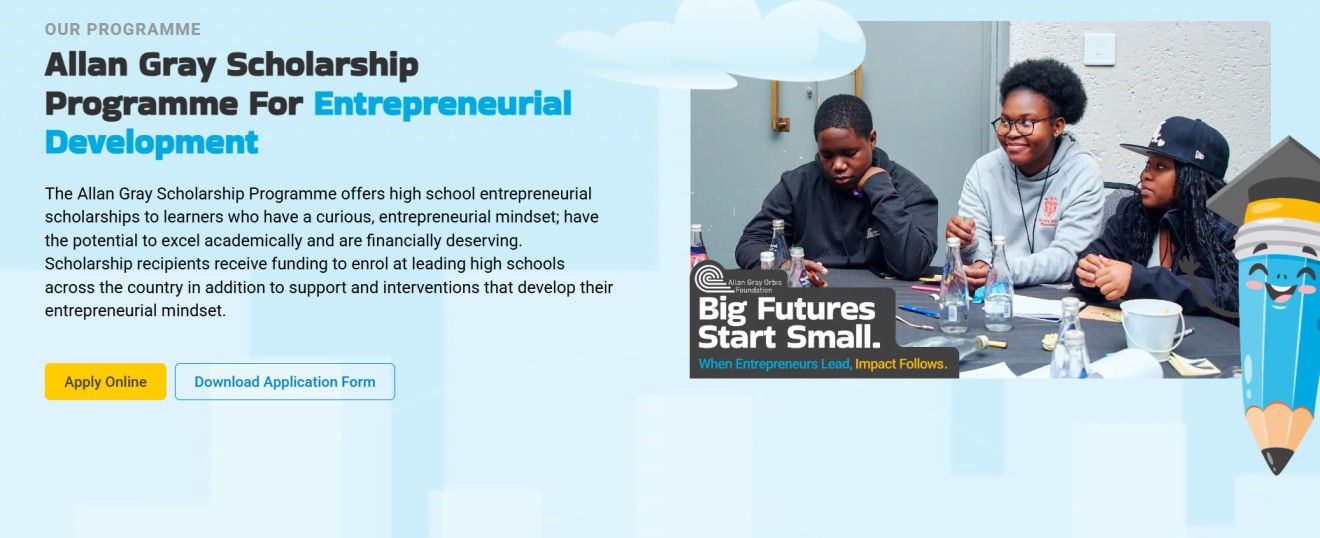
The Allan Gray Scholarship Programme offers high school entrepreneurial scholarships to learners who have a curious, entrepreneurial mindset; have the potential to excel academically and are financially deserving. Scholarship recipients receive funding to enrol at leading high schools across the country in addition to support and interventions that develop their entrepreneurial mindset.

The programme aims to produce a confident scholar with entrepreneurial thinking, unlocked potential, leadership qualities, a desire to create value, the ability to solve problems, an aspiration and intention to be a Allan Gray Fellow, an understanding of the culture of community and collaboration, and a positive attitude. The Allan Gray Scholarship Programme is designed to equip the youth with an entrepreneurial mindset to enable future generations to redress the inequalities of the past and to continue the economic and social transformation of South Africa.

The Programme fosters the curiosity and potential already exhibited by these learners through a combination of face-to-face, online and peer learning, as well as one-on-one interventions. The curricula of leading partner high schools are supplemented by mentorship, provided by a dedicated Programme Officer. Allan Gray Scholars complete the programme with an understanding of entrepreneurship and an appreciation of the culture of community and collaboration. They are inspired to create value as part of their entrepreneurial career and are looking forward to becoming Allan Gray Fellows.

Scholarship Application Requirements and Process

Download Application Form

Requirements

  • Applicant must be a current Grade 6 learner in the year of application
  • Applicant must be a South African citizen
  • Applicant must not be older than 12 and not younger than 11 in Grade 6 (Applicants must be born in 2014 or 2015)
  • Applicant must demonstrate financial need
  • Applicant must obtain a minimum of 70% for both English and Mathematics

Process

  • Submit a copy of your application form and supporting documentation
  • Successful applicants will be required to write the Foundation assessment in English and Mathematics for Grade 6 in December 2026
  • After the Foundation assessment, successful candidates will be invited for interviews in early 2027
  • Recommended candidates will be invited to the placement schools for interviews
  • Candidates whose recommendations are approved by the placement schools will be awarded the Allan Gray Scholarship in May 2027
  • Once the Allan Gray Scholarship is awarded, the Foundation, placement school, and the Scholar’s custodian sign a Memorandum of Agreement.

What the Scholarship Offers

  • Tuition and boarding
  • A monthly allowance
  • Toiletries, uniforms and casual clothing
  • Support for extra murals
  • Stationery and textbooks
  • Workshops
  • Annual entrepreneurial conference
  • Online Learning Campus
  • Programme Officer (mentorship)
  • Like-minded community
  • Gain confidence
  • Develop entrepreneurial mindset
  • Growth mindset
  • Develop leadership qualities
  • Access to interactive online learning
  • Access to speakers and seminars
  • Entrepreneurial mindset development through collaboration and a community of like-minded individuals

HOW TO APPLY

APPLY HERE

Vodacom External Bursary Programme for Ambitious and Driven Students in their First, Second, or Third Year of Study

Vodacom External Bursary Programme for Ambitious and Driven Students in their First, Second, or Third Year of Study

Ready to invest in your future? The Vodacom External Bursary Programme could be your next big step.

This academic merit bursary is designed for ambitious, driven students in their first, second, or third year of study. Whether you’re already studying or planning to pursue a qualification in Science, Technology, Engineering, Mathematics (STEM), or even Business and Commercial fields—this opportunity is for you.

Key Offerings:

  • Full university accommodation
  • Capped amount – private accommodation
  • Full registration and Tuition
  • Text book allocation
  • Meal allowance

Additional Benefits:

  • Laptop
  • Cellphone
  • Orientation workshop for all new students who are accepted on the programme
  • Workplace exposure through our structured Vacation Work programme
  • Work Readiness skills training to prepare the final year bursars into the world of work
  • Full access to our Wellness Programme in partnership with Lyra Wellbeing Services

ALSO CHECK: Nine CV Mistakes Costing You Job Interviews in South Africa – Check And Correct

Programme Requirements

  • must be a South African citizen by birth
  • must undertake full-time undergraduate studies in a South African tertiary institution
  • must pass Grade 12 with exemption, obtaining an average of 70% or higher across all subjects
  • must have obtain a minimum of 65% average or higher if in first year of tertiary and above

Applying for the Bursary Programme position

Step 1: Before you can apply for a position, please ensure that you meet all of the above criteria. For the best application experience, we recommend using a desktop, laptop, or tablet (e.g., iPad) with Google Chrome to ensure optimal compatibility and readability.

Step 2: Once you have fulfilled step one, please click on the “Apply Now” button to register and apply. When submitting your application, please ensure that you attach a copy of your most recent academic transcript.

Step 3: Once you’ve registered and applied, we’ll email you confirmation of receipt. Our Bursary Management Team will then carefully assess your application and provide you with feedback every step of the way!

Applications will close 31 August 2026

HOW TO APPLY

CLICK HERE TO APPLY

How to Write a Bursary Motivational Letter That Actually Gets Read in South Africa

How to Write a Bursary Motivational Letter That Actually Gets Read in South Africa

If you are applying for a bursary in South Africa, let me tell you something straight: your motivational letter is not a formality. It is often the part that decides whether the person reading your application sees a serious young person with potential, or just another student asking for help. In a country where thousands of bright learners and students are trying to study with limited resources, a strong bursary motivational letter can make all the difference.

A lot of South African youths write letters that sound too desperate, too vague, or too copied from the internet. Others write like they are trying to impress with big words instead of telling their real story. That is where they lose the reader. A good motivational letter is not about sounding clever. It is about sounding sincere, focused, and worthy of trust.

I want to show you how to write one properly, in a way that feels natural, real, and relevant to the South African context. I’ll also share practical examples so you can understand what works and what does not.

What a bursary motivational letter is really for

Apart from your CV, a bursary motivational letter is your chance to explain why you need the funding, why you deserve it, and what you plan to do with the opportunity if you get it. Think of it as your voice when you are not in the room. Your marks show performance, your documents show facts, but your letter shows your character, purpose, and drive.

In South Africa, many bursary providers are not only looking for top academic results. They also want students who are committed, responsible, and likely to succeed. They want to know that if they invest in you, you will not waste the opportunity. That is why your letter should answer three big questions:

  • Why do you need this bursary?
  • Why are you the right candidate?
  • What will you do with this opportunity?

If you answer those clearly, you are already ahead of many applicants.

Start with honesty, not drama

One of the biggest mistakes young people make is overdoing the story. Some letters sound like a soap opera. Others try too hard to make the reader feel sorry for them. Yes, your background may be tough. Yes, you may come from a home where money is tight. Yes, you may be the first in your family to study. All of that is important. But the key is to write about it with dignity.

For example, instead of writing:
“I am the poorest person in my community and I have suffered a lot in life.”

You can write:
“I come from a family with limited financial means, and my parents have done their best to support my education despite the many pressures they face. A bursary would ease this burden and allow me to focus fully on my studies.”

That sounds stronger because it is honest, respectful, and mature. In South Africa, many students are carrying heavy family responsibilities. A good motivational letter does not hide that reality. It shows how you are responding to it.

Open with a clear purpose

Your first paragraph should tell the reader exactly why you are writing. Do not waste time. Bursary reviewers read many applications, so they need to understand your point quickly.

A simple opening can look like this:

“I am writing to apply for the [Bursary Name] to support my studies in [Course Name] at [Institution Name]. I am a hardworking and dedicated student who is determined to complete my qualification and contribute meaningfully to South Africa’s future.”

That opening works because it is clear. It tells the reader who you are, what you are applying for, and what your attitude is. You do not need fancy language. You need clarity.

Tell your story in a way that shows growth

This is where many students either go too shallow or too emotional. Your story should show progress. The reader wants to see where you started, what challenges you faced, what you achieved, and where you are heading.

Let’s say a student from Soweto finished matric with strong marks but needs help to study accounting. A weak letter would just say, “I need money to go to university.” A stronger letter would say something like:

“I developed a strong interest in accounting while helping my aunt with basic bookkeeping in her spaza shop. I saw how proper record-keeping helped her understand profit, stock, and expenses more clearly. That experience made me want to study accounting so that I can build a career in finance and one day help small businesses manage their money better.”

That is a story with direction. It shows interest, exposure, purpose, and ambition. It also connects the student’s life experience to the course they want to study.

Show that you understand the value of the bursary

A bursary is not just financial support. It is an investment. That means your letter should show that you understand the responsibility that comes with it. You are not just asking for money. You are asking someone to believe in your future.

You can say things like:

  • This bursary will allow me to focus on my studies without constant financial stress.
  • It will reduce the burden on my family.
  • It will help me complete my qualification on time.
  • It will give me the chance to become a productive member of society.

In South Africa, where families often stretch every rand, many students have to choose between education and survival. A bursary can change that. Your letter should make it clear that you understand how serious that opportunity is.

Keep it personal, but professional

A bursary motivational letter should sound like a real person wrote it. It should not sound like a robot or a copied template. But it should also not sound like a WhatsApp message to a friend. You want the right balance: warm, respectful, and professional.

Here is the kind of tone you should aim for:

  • Confident, but not arrogant.
  • Honest, but not overly emotional.
  • Personal, but not too casual.
  • Professional, but not stiff.

For example, a student in Limpopo applying for a teaching bursary might say:

“I have always admired the role teachers play in shaping young lives, especially in communities where good education can change the direction of a family. Growing up, I saw how one committed teacher helped many learners in my area believe in themselves. That influence inspired me to pursue teaching as a long-term career.”

That sounds human. It sounds real. It also sounds like someone who has thought carefully about their future.

Include your academic effort and discipline

A good bursary letter should not only speak about need. It should also show effort. Even if your marks are not perfect, there is probably something worth highlighting:

  • Improvement over time.
  • Good performance in key subjects.
  • Leadership roles at school.
  • Participation in sports, debating, or community work.
  • Consistency and discipline.

For example, if you improved from average results in Grade 11 to strong results in Grade 12, say so. If you were class representative, mention it. If you helped tutor other learners, include it. These details help the reader see that you are active, responsible, and committed.

A bursary provider wants to know whether you will use the funding wisely. Evidence of discipline helps answer that.

Write about your future plans

This part is important because it shows that you are not only thinking about now. You are thinking about what comes after the bursary.

You can explain:

  • What career you want.
  • How the course fits your goal.
  • What you plan to do after graduating.
  • How you hope to give back.

For example:
“My long-term goal is to become a civil engineer and contribute to infrastructure development in South Africa, especially in underserved communities where roads, water systems, and housing remain major challenges. I want to use my qualification not only to build a career, but also to help improve living conditions in the communities that raised me.”

That kind of statement gives the bursary provider confidence that their support has purpose. It shows you are thinking beyond yourself.

Do not overstate hardship

One of the quickest ways to weaken your letter is to exaggerate. Bursary committees can usually tell when a student is overselling their struggle. You do not need to invent a tragedy to be considered.

If your family is struggling financially, say so clearly and respectfully. If your parent is unemployed, if you are being raised by a single guardian, if there are many siblings, or if the household income is low, those facts matter. But write them calmly. Do not try to guilt the reader.

A good example:
“My family has made great sacrifices to support my education, but the cost of tuition, accommodation, and study materials is becoming difficult to manage. Receiving this bursary would ease that pressure and allow me to remain focused on my studies.”

That is enough. Clear, respectful, and persuasive.

One page is usually enough

Many young people think a longer letter looks more serious. It does not. In most cases, one page is enough, and two pages should be the maximum unless the application specifically asks for more.

Why? Because decision-makers are busy. If your letter is too long, they may stop reading before they get to the best part. Keep it focused. Every paragraph should have a reason to exist.

A strong structure could look like this:

  1. Introduction.
  2. Your background and reason for applying.
  3. Your academic record or achievements.
  4. Your future plans.
  5. Closing paragraph.

That is enough to make a strong impression without losing the reader.

Use plain, strong language

You do not need to sound like a legal document. Use simple English that is clear and clean. Some students think using big words makes them sound intelligent. Often, it just makes the letter harder to read.

Instead of writing:
“I am a profoundly industrious and exceptionally diligent scholar with an unwavering proclivity for academic excellence.”

Write:
“I am a hardworking student who is committed to doing well in my studies and building a meaningful future.”

The second version is better because it is readable, direct, and natural.

Real life example of a strong letter

Let’s imagine a young woman from KwaZulu-Natal applying for a nursing bursary. Her mother works informally, her father is absent, and she has always helped care for younger siblings. She writes:

“I am applying for this bursary because I want to study nursing and build a career in healthcare. Growing up, I saw how difficult it is for families in my community to access support and reliable care. This inspired me to pursue a profession where I can make a real difference in people’s lives. My family has supported me as much as possible, but the cost of further studies is a challenge. A bursary would allow me to continue my education, focus fully on my training, and one day give back through quality healthcare service.”

That letter works because it is honest, relevant, and forward-looking. It does not beg. It explains. It does not boast. It shows purpose.

What not to do

Here are some common mistakes that can spoil a good application:

  • Writing a generic letter and sending the same one everywhere.
  • Copying from the internet without making it personal.
  • Using slang or casual language.
  • Focusing only on need and not on merit.
  • Making the letter too long.
  • Failing to mention your course or future plans.
  • Leaving spelling and grammar mistakes.
  • Sounding desperate instead of focused.

A bursary letter is not a place to show off. It is a place to show that you are ready.

A simple formula you can follow

If you are not sure how to start, use this easy structure:

  • Paragraph 1: Introduce yourself and state the bursary you are applying for.
  • Paragraph 2: Explain your background and why you need the support.
  • Paragraph 3: Talk about your academic performance, skills, or achievements.
  • Paragraph 4: Explain your career goals and how the bursary will help.
  • Paragraph 5: Close respectfully and thank the reader for considering your application.

That formula works for learners, university students, TVET students, and even young people applying for study-related support. It keeps you organised and helps the reader follow your thinking.

Final encouragement for South African youths

If you are writing a bursary motivational letter, do not think of it as just another school task. Think of it as your chance to speak for your future. Many young South Africans have the ability, but not the resources. A good letter can help close that gap. It can open a door that your marks alone may not open.

So write with honesty. Write with purpose. Write like someone who respects the opportunity and is ready to grow from it. Your story matters, especially in a country where so many young people are fighting for a chance to study, work, and build something meaningful.

And while you are building that future, make sure you follow Careers South Africa at https://www.careerssouthafrica.co.za/ as your plug for internships, learnerships, and other youth opportunities in South Africa.

Get Daily Job Opportunities To Your Inbox!

Follow us on our Social Media Handles to remain connected to daily opportunities:

Facebook: https://www.facebook.com/careerssouthafrica/

Linkedin: https://www.linkedin.com/company/careers-south-africa-za/

WhatsApp Group: https://chat.whatsapp.com/JVphaaPQEOU9VBlpVJAtIi?mode=gi_t

Western Cape Mobility Department is Recruiting Traffic Students for the Road Traffic Law Enforcement Bursary – R5000 per month

Western Cape Mobility Department is Recruiting Traffic Students for the Road Traffic Law Enforcement Bursary - R5000 per month

Full-Time Study Bursary: Student Cadet Traffic Officer (various locations), Ref No. WCMD 08/2026

Closing Date: 2026/05/05
Job Title: Full-Time Study Bursary: Student Cadet Traffic Officer (various locations), Ref No. WCMD 08/2026
Department: Western Cape Mobility Department
Job Type: Bursary
Location – Country South Africa
Location – Province Western Cape
Location – Town / City Worcester, Laingsburg, Beaufort West, Oudtshoorn, Brackenfell, Somerset West, Vredendal, Vredenburg, Caledon, Swellendam, Mosselbay, George, Knysna

Job Purpose: Western Cape Mobility Department is Recruiting Traffic Students for the Road Traffic Law Enforcement Bursary

The Western Cape Mobility Department will be recruiting Traffic Students for the completion of a Further Education and Training Certificate: Road Traffic Law Enforcement on a Bursary. This is a twelve (12) month training course which will commence on 08 June 2026 at the Gene Louw College (GLTC), Brackenfell.

The various Traffic Centres are as follows: Worcester, Laingsburg, Beaufort West, Oudtshoorn, Somerset West, Brackenfell, Vredenburg, Vredendal, Knysna, Mosselbay, Calledon, Swellendam and George.

Minimum Requirements

Grade 12 (Senior Certificate or equivalent qualification); Valid motor vehicle license (manual) code B; Applicant must be physically fit, pregnant persons will not be considered as physical tasks during recruitment and subsequent training may pose a threat to the unborn child and/or mother; Visible tattoos and body piercings (except females with one piercing in each ear) will disqualify an applicant as this will not compliment uniformity in a uniform wearing environment; No criminal record; All potential shortlisted candidates will be required to submit a medical certificate stating they can be exposed to strenuous physical exercise, Medical certificate needs to state result of pregnancy test and free from drugs, Potential shortlisted candidates may be required to undergo a psychometric test.

Successful candidates will undergo a full Medical, Psychological, Drug assessment at a Provincial Testing facility prior to admission. Physical fitness, Driving and Written assessment, and an interview. Fingerprint or Identity number clearance for criminal records via SAPS. Undergo ongoing fitness and drug testing assessments for the duration of the course. Well versed with the home language of the majority of residents in a specific area where the successful incumbents will be appointed. People older than 35 years cannot apply.

Recommendation

Key Performance Areas

Enforce road traffic, public passenger and transport legislations; Provide visible traffic control/policing and promote/ensure crime prevention activities; Perform all administrative activities and related duties. Adherence to the terms and conditions of the signed 12 – month contract for the duration of the training program which includes practical deployment on a 24/7 shift system when needed.

Competencies: Good written and verbal communication skills in at least two of the three official languages of the Province; Good interpersonal and public relations skills; Ability to work under pressure; Assertive and confident personality; Ability to work in a team and independently.

Remuneration: A training stipend of R 5 000.00 per month will be paid monthly for the duration of the training period.(This excludes meals and accommodation)

Notes

Shortlisted candidates will be required to attend interviews on adate and time determined by the department and submit documentation for verification purposes and criminal record vetting. All shortlisted candidates shall undertake two pre-entry assessments. One will be a practical exercise to determine acandidate’s suitability based on the post’s technical and generic requirements and the other must be an integrity (ethical conduct) assessment. The selection process will be guided by the EEtargets of the employing department.

Please note that no permanent employment is offered. Any future permanent positions will be filled through a competitive selection process, and all candidates will be required to apply in accordance with DPSA 2016 regulations.

By applying for this position, you are consenting to the Western Cape Government contacting your previous employers/managers for an employment reference. Reference checks will include enquiries relating to your disciplinary records and reasons for leaving.

Should you experience difficulties with your online application,technical support is available from Monday to Friday from 08:00to 16.00. Contact the helpline at 086 137 0214. For all otherqueries relating to the position, kindly contact the enquiries person as indicated in the advert. Please ensure that you submit your application before the closing date as no late applications will be considered.

HOW TO APPLY

APPLY HERE

Rand Water External Bursary Program Scheme for Undergraduate Students

Rand Water External Bursary Program Scheme for Undergraduate Students

Closing Date: 07 May 2026
Reference Number: RAN260423-1
Job Title: Rand Water External Bursary Program
Location – Country South Africa
Location – Province Gauteng
Location – Town / City Glenvista
Location – Site Rietvlei

Job Advert Summary: Rand Water External Bursary Program Scheme

Rand Water invites undergraduate students who are interested in joining the Water Sector an opportunity to apply for the 2026 External Bursary Scheme for following disciplines:

  • B. Tech or Bsc Degree in Civil Engineering: 1st year or 2nd year x 2
  • Bsc in Water Science and Sanitation Science: 2nd year x 1
  • Bsc Hons in Chemistry: 2nd year x 1
  • Diploma in Water Science and Technology: 2nd year x 1
  • B. Arch (Bachelors of architecture): 1st or 2nd year x 1
  • BSc or BEng in Electrical/Electronic Engineering: 1st year or 2nd year x 4
  • Bachelor of Geomatics / Surveying:1st year x 1
  • Bsc in Mechanical Engineering: 1st or 2nd year x 1
  • Bcom Accounting: 1st or 2nd year x 1
  • LLB: 2nd year x 3
  • Bsc Hons in Microbiology: 1st or 2nd year x 1
  • Masters of Public Health: 2nd year x 1

Minimum Requirements For Rand Water Bursary

· South African citizens.
· Previously disadvantaged individuals (ACI).
· Have Passed Matric or equivalent and currently studying within one of the aforementioned fields of study.
· Meet minimum average of 65% and academic performance in major subject.
· Not in possession of other bursary/funding
· Applicant must be under the age of 35 years
· Applicants must be full-time students at registered and recognized tertiary educational institution.

The following documents must accompany your application:
· Certified copy of ID Document
· Certified copy of Matric Certificate
· Latest Academic Record
· Proof of registration for current academic year

Primary Duties
As a Bursar you are expected to complete qualification on record time in line with Bursary Contract/Agreement

Knowledge: Rand Water Mandate and its contribution to the water sector

Skills: Communication skills (verbal and written)

Attitude: Self-motivated and results – driven

About Rand Water

Rand Water is Africa’s largest bulk water utility, providing potable water to over 11 million people across Gauteng and parts of Mpumalanga, Free State, and North West. Established in 1903, it supplies water to municipalities, which then manage final distribution to consumers. The utility draws water from the Vaal Dam and manages the entire purification process to meet stringent standards.

HOW TO APPLY

APPLY HERE

ALSO CHECK: Mukuru Customer Support Learnership Opportunity – Johannesburg, Pretoria And Cape Town

Get Connected!

Follow us on our Social Media Handles to remain connected to daily opportunities:

Facebook: https://www.facebook.com/careerssouthafrica/

Linkedin: https://www.linkedin.com/company/careers-south-africa-za/

WhatsApp Group: https://chat.whatsapp.com/JVphaaPQEOU9VBlpVJAtIi?mode=gi_t

WhatsApp Channel: https://whatsapp.com/channel/0029Vb7gAx5J3jupoQfCwt2n

Actuarial Science Bursary At Old Mutual South Africa – Apply And Be Considered

Actuarial Science Bursary At Old Mutual South Africa - Apply And Be Considered

Job Description

Exceptional South African learners pursuing or interested in pursuing studies in Actuarial Science are invited to apply for the Old Mutual Bursary Programme. The bursary programme comes with comprehensive support during university to the day you qualify and beyond into a meaningful career at Old Mutual. It also offers opportunities for personal development, vacation work, networking, and guaranteed employment post-graduation.

Old Mutual Actuarial Bursary Programme

Old Mutual Limited (OML) is a premium African financial services group that offers a broad spectrum of financial solutions to retail and corporate customers across key markets in 14 countries.

Old Mutual purpose is to help its customers thrive by enabling them to achieve their lifetime financial goals, while investing their funds in ways that will create a positive future for them, their families, their communities and broader society. In this way, the company significantly contribute to improving the lives of its customers and their communities while ensuring a sustainable future for Old Mutual business.

What the bursary covers

The bursary covers tuition, study materials, meals, accommodation in residence and return flights home (if studying outside of your hometown). You will receive financial support for the full duration of your degree and students who achieve excellent grades will receive more incentives.

Eligibility Criteria: To be eligible to apply you must meet the following requirements:

General:

  • You must be a South African citizen
  • You must have at least 80% in Mathematics, 60% for English HL or 70% for English FAL, 70% for all your other subjects
  • You must have applied/ be studying at either:
  • North-West University
  • Stellenbosch University
  • University of Cape Town
  • University of Pretoria
  • University of the Free-State
  • University of the Witwatersrand
  • University of Johannesburg
  • University of Kwa Zulu Natal – no longer ASSA accredited

You must be committed to qualifying as an actuary and work for the company after graduation.

The Application Process

  • Applications must be submitted online at: www.oldmutual.co.za/careers/actuarial-bursary
  • Download and complete the bursary motivation form then complete the online application which includes a gamified assessment (it is not timed). You will be required to attach aone-page CV.
  • Shortlisted candidates will be sent a link to complete psychometric assessments. Top 30 finalist
  • Finalists will be invited to a virtual interview
  • Should you be selected after the interview you will receive a provisional offer which will be confirmed once we receive your final matric results and proof of acceptance at University for an Actuarial Science or Accounting Science programme.

Required Documentation (to be included in the application)

Important Notes

  • Parental/guardian consent is required if you are under 18
  • Preference will be given to candidates from under-represented designated groups, including candidates with disabilities
  • Preference will be given to previously disadvantaged background or demonstrate financial need
  • Incomplete applications will not be considered

Applications close 30 May 2026

If you have not heard from Old Mutuual by 31 July 2026, please consider your application unsuccessful. For any queries, contact the Old Mutual Early Careers team by emailing earlycareers@oldmutual.com

Skills: Data Analysis, Data Compilation, Data Controls, Information Management, Numerical Aptitude, Planning and organisational skills, Risk Management

Competencies: Action Oriented, Being Resilient, Builds Networks, Communicates Effectively, Ensures Accountability, Financial Acumen, Instills Trust, Manages Complexity

Education: High School (Grade 12)

Closing Date: 30 May 2026 , 23:59

HOW TO APPLY

CLICK HERE TO APPLY

Most Important!

Follow us on our Social Media Handles to remain connected to daily opportunities:

Facebook: https://www.facebook.com/careerssouthafrica/

Linkedin: https://www.linkedin.com/company/careers-south-africa-za/

WhatsApp Group: https://chat.whatsapp.com/JVphaaPQEOU9VBlpVJAtIi?mode=gi_t

WhatsApp Channel: https://whatsapp.com/channel/0029Vb7gAx5J3jupoQfCwt2n