NSFAS 2027 Documents Checklist: Don’t Submit Your Application Without These Papers

NSFAS 2027 Documents Checklist: Don’t Submit Your Application Without These Papers

NSFAS 2027 Documents Checklist: Don’t Submit Your Application Without These Papers

Applying for NSFAS 2027 funding can feel stressful, especially when you are trying to complete the application while also preparing for university or TVET college. One of the most important parts of the process is submitting the correct supporting documents. A missing, unclear or incorrectly completed document can delay the assessment of your application or cause it to be marked incomplete.

Applications for the 2027 academic year opened on 18 September 2026 and close on 31 October 2026. Applying is free, and students must apply through the official myNSFAS platform or the official NSFAS mobile application. Before you click “submit”, use this guide to check that your documents are ready, readable and uploaded in the correct place.

Start with your identity documents

Every applicant should have valid identity information ready. This normally includes your South African ID details or a clear copy of your smart ID card. If you have a smart ID card, make sure both sides are visible if the application asks for a copy.

If you are younger than 16 and do not have an ID document, NSFAS may require a birth certificate. Your name, surname and identity number should match your official Home Affairs records exactly.

For example, if your ID says “Thandeka Nomsa Mokoena” but your application says “Thandeka Mokoena,” check the information carefully before submitting. Small differences can create verification problems.

Your document should be:

  • Clear and easy to read.
  • Fully visible from edge to edge.
  • Free from glare and shadows.
  • Uploaded in the required document slot.
  • Consistent with the personal details entered on your application.

Do not upload a photograph where part of the ID number is hidden by a finger, reflection or poor lighting.

The NSFAS consent form

The consent form is one of the most important documents in the application process. It gives NSFAS permission to verify information about you and your household against information held by organisations such as the South African Revenue Service and the Department of Home Affairs.

The form generally requires signatures from:

  • The applicant.
  • A parent.
  • A legal guardian.
  • A spouse, where applicable.

Use the correct 2027 form. Do not rely on an old form from a previous application year unless NSFAS specifically instructs you to do so.

The official instructions say that the form must be completed in capital letters, using black ink. Electronic signatures are not accepted. If more than one signature is required, make sure every relevant person signs in the correct space.

Example

Sipho is 19 years old and still depends financially on his mother. He should complete his section of the consent form and ensure that his mother completes and signs the parent section. If his father is not part of the household and does not support him, Sipho should follow the instructions in myNSFAS about whether an additional explanation or supporting document is needed.

Do not sign on behalf of another person unless the official process allows it. If a parent or guardian is required to sign, that person should sign the form themselves.

The declaration form

Applicants aged 34 and younger may be required to submit the NSFAS declaration form. This document helps NSFAS verify parent or legal-guardian information captured in the application. Many students confuse the declaration form with the consent form. They are not necessarily the same document, and your application may require both.

Before uploading:

  • Download the current 2027 version.
  • Complete it in capital letters.
  • Use black ink.
  • Make sure all required signatures are present.
  • Check that names and identity numbers match the application.
  • Scan or photograph the entire form.
  • Upload all pages if the form contains more than one page.

A common mistake is to complete the form but forget to sign it. Another is to upload only the first page. Check the document carefully before submission.

Documents for parents or guardians

NSFAS needs household information to assess whether an applicant meets the relevant financial criteria. Depending on your family circumstances, you may need to provide information or documents relating to your parents, legal guardian or spouse.

The NSFAS supporting-document information refers to documents such as:

  • Copies of parents’ or guardians’ identity documents.
  • Income information.
  • Payslips.
  • UIF documentation.
  • Pension information.
  • Affidavits for informal income.
  • Legal guardianship documents.
  • Marriage documents.
  • Divorce documents.
  • Death certificates.

The exact documents required may depend on the information in your application. Always check the document list generated in your myNSFAS account rather than uploading random paperwork.

If a parent is employed

A parent or guardian who earns a salary may need to provide recent proof of income, such as payslips or an official employment letter. NSFAS’s checklist refers to recent employment or income documents and may require information for each person contributing to the household income.

For example, if your mother works as a nurse and your stepfather works for a private company, you may need to provide income documents for both, depending on how your household details are recorded.

Make sure the documents are recent and readable. An old payslip may not accurately reflect the household’s current financial circumstances.

If a parent is self-employed or an informal trader

Not every household receives a formal monthly payslip. If a parent sells food, operates a small business, works as a taxi operator, does casual construction work or earns income informally, an affidavit may be required to explain the nature of the work and income.

The affidavit should be truthful and complete. It should explain:

  • The person’s type of work.
  • How long they have been doing it.
  • Whether the income changes from month to month.
  • The approximate income, where required.
  • Who depends on that income.

Do not invent a salary figure. Giving false information can create serious problems later.

If a parent has passed away

If one or both of your parents are deceased, NSFAS may require a death certificate for each deceased parent. The certificate helps explain why a parent’s income or consent information cannot be provided.nsfas.org+1

Keep a clear copy ready. If you do not have the document, contact the relevant family member or government office as soon as possible rather than leaving the application incomplete.

Example

Lerato’s father died several years ago, and she lives with her mother. In her application, she should accurately indicate her father’s status and upload the required death certificate if requested. She should not attempt to provide income documents or a signature that cannot reasonably be supplied.

If your parents are divorced or separated

Applicants whose parents are divorced or separated may be asked for supporting documents such as:

  • A divorce decree.
  • A maintenance or settlement agreement.
  • An affidavit explaining the family circumstances.
  • Information about the parent who provides financial support.

The purpose is to help NSFAS understand the household structure and determine whose income should be considered.

If a parent does not live at home, do not automatically assume that their information is irrelevant. Answer the application questions honestly and upload whatever myNSFAS requests.

If you live with a legal guardian

Students who are raised by someone other than a biological parent may need proof of legal guardianship. This could include a court-issued guardianship document or another official document accepted by NSFAS.

A letter from a relative saying “this child lives with me” may not be enough if the application specifically requests legal proof.

If you are uncertain, contact NSFAS or ask your institution’s financial-aid office for guidance. Do not submit a document simply because it sounds relevant; submit the document requested for your particular situation.

If you receive a SASSA grant

NSFAS states that certain SASSA grant information can be verified electronically. The 2027 application information indicates that applicants should still follow the instructions displayed in their myNSFAS account, while some grant information may be verified directly with SASSA.

The official document list is important here. Do not upload unnecessary documents just because someone on social media said they are always required. Check what appears in your account and provide additional proof if NSFAS specifically requests it.

If a SASSA grant contributes to the household income and the system asks for a supporting letter or grant document, upload a clear copy.

Disability-related documents

Students living with a disability may need to complete the NSFAS Disability Annexure and provide a medical report signed by a qualified medical practitioner.

The disability documentation should be completed carefully. Do not leave the medical section for the last day because you may need an appointment with a doctor or other qualified practitioner.

The official 2027 information says that the medical report and disability annexure should be combined into one file where required before uploading. Check the portal instructions carefully so that you do not upload only one part of the documentation.

Example

A student with a long-term medical condition should download the correct disability form, complete the applicant section, arrange for the medical practitioner to complete the relevant section, attach the medical report and combine the pages into one clear file if the portal requests one file.

A blurry phone photograph of a medical report may be rejected. Take the photograph in good light and check every page before uploading.

Orphan or vulnerable child documentation

Applicants who are orphans or vulnerable children may need to complete the NSFAS Orphan or Vulnerable Child Declaration form. The 2027 information says that this form applies to applicants under 18 who meet the relevant requirements and may involve a social worker or authorised official.

This form is not for every student who has financial difficulties. Use it only if your circumstances fit the official definition and the application asks for it.

You may also need supporting information such as:

  • A death certificate.
  • A social worker’s letter.
  • Legal-guardian information.
  • A court document.
  • An explanation of who currently cares for you.

If you are unsure, ask a social worker, school official, college administrator or NSFAS for assistance.

Academic documents

Some applicants may need to submit academic records, such as:

  • A latest academic transcript.
  • Examination results.
  • Proof of registration.
  • Proof of acceptance.
  • A Grade 12 result, where applicable.

The general NSFAS checklist refers to an academic transcript or examination results, although current Grade 12 learners may not need to submit this document at the application stage.

If you are already studying at a university or TVET college, keep your latest academic record available. If you have been accepted but have not yet registered, keep your acceptance letter safe in case the portal requests it.

Do not upload an unofficial screenshot if the application specifically asks for an official academic record.

Documents for dependants who are students

If another person in your household is studying at a university or TVET college, NSFAS may ask for proof of that person’s registration or acceptance.

This can help explain the financial responsibilities within the household. Ask the dependant for an official registration letter or acceptance document rather than sending an informal message or social-media screenshot.

How to prepare your documents

You do not necessarily need an expensive scanner. A smartphone can produce a suitable copy if you use it correctly.

Follow these steps:

  1. Place the document on a flat, dark surface.
  2. Use natural light or a bright room.
  3. Keep the phone directly above the document.
  4. Ensure all four corners are visible.
  5. Do not use flash if it creates glare.
  6. Check that the words and numbers are readable.
  7. Save the file with a clear name.
  8. Upload it to the correct slot on myNSFAS.
  9. Confirm that the upload was successful.
  10. Keep a copy of the submitted document.

For a multi-page form, combine all pages into one file if the portal requests a single document. Do not upload page one in one slot and page two somewhere else unless the system specifically instructs you to do so.

Why documents get rejected

Students often believe that a document was rejected because they are not eligible. Sometimes, the problem is much simpler: the document cannot be read or does not meet the formatting requirements.

Common problems include:

  • A cropped page.
  • A blurred photograph.
  • Glare covering an ID number.
  • A missing signature.
  • A typed signature.
  • Coloured ink instead of black ink.
  • Correction fluid.
  • An outdated form.
  • Only one page uploaded.
  • Names that do not match.
  • An incorrect document uploaded in the wrong slot.
  • A document that is too old.
  • An affidavit that does not explain the circumstances.

The current NSFAS application guidance specifically warns applicants to ensure that every corner is visible, that the text can be read, that signatures are handwritten, and that the correct 2027 forms are used.

A sample document folder

Create a folder on your phone, computer or email account called:

NSFAS 2027 Application

Inside it, save:

  • Your ID copy.
  • Parent or guardian ID copies.
  • Signed consent form.
  • Declaration form, if required.
  • Payslips or income documents.
  • SASSA documentation, if requested.
  • Death certificate, if applicable.
  • Divorce or maintenance documents, if applicable.
  • Guardianship documents, if applicable.
  • Disability annexure and medical report, if applicable.
  • Orphan or vulnerable child documents, if applicable.
  • Academic results or transcript.
  • Proof of acceptance or registration, if requested.
  • Your application reference number.
  • A screenshot showing successful submission.

This simple folder can save you time if NSFAS later asks for a document again.

Submit early and track your application

The 2027 NSFAS application period closes on 31 October 2026. NSFAS says applicants should submit their forms and supporting documents before the closing date and track progress through myNSFAS. Do not assume that submitting the form means the process is finished. Log in regularly to check whether NSFAS has:

  • Requested another document.
  • Marked a document as unreadable.
  • Updated your application status.
  • Asked you to correct information.
  • Issued a decision.
  • Opened an appeal option.

The NSFAS website states that applicants may receive a request to submit missing documents and should upload them within the period provided through the portal. Missing that request can leave your application incomplete.

Stay safe from scams

NSFAS applications are free. You do not need to pay a person to apply, speed up the process or guarantee funding.

Use only official NSFAS channels. Be careful of people who:

  • Ask for your myNSFAS password.
  • Request your one-time PIN.
  • Promise guaranteed approval.
  • Demand payment for a free application.
  • Ask you to send documents through an unknown WhatsApp number.
  • Offer to change your household income information.
  • Claim they can bypass the application system.

NSFAS advises users not to share passwords or one-time PINs. Keep your login details private, even if someone claims to be helping you.

If you need assistance, ask a trusted family member, school official, campus financial-aid office or NSFAS directly. You should remain in control of your own account.

Final checklist before submitting

Before clicking submit, ask yourself:

  • Have I entered my name exactly as it appears on my ID?
  • Is my identity document clear?
  • Have the required parents, guardian or spouse signed the consent form?
  • Did I use black ink?
  • Did I use the correct 2027 form?
  • Have I uploaded every page?
  • Are all corners visible?
  • Have I provided the relevant income documents?
  • Have I included documents explaining my family circumstances?
  • Did I attach disability or orphan documentation if applicable?
  • Did I check the document list in myNSFAS?
  • Did I save my reference number?
  • Did I receive confirmation that the application was submitted?

If the answer to all relevant questions is yes, your application is in a much stronger position for assessment.

Conclusion

Preparing your documents properly is one of the easiest ways to avoid unnecessary delays with NSFAS 2027. Gather your papers early, use the correct forms, complete them in black ink, upload clear copies and check your myNSFAS account regularly before and after submission. For additional opportunities, career guidance and practical job-search advice, visit Careers South Africa for daily job updates, learnerships, internships, bursaries and job tips that can help you take the next step after school or college.

Dis-Chem Dispensary Support Learnership Programme – Weskus, Vredenburg and Western Cape

Work as a Millwright Artisan at Clover South Africa: Five(5) Positions Available

Work as a Millwright Artisan at Clover South Africa: Five(5) Positions Available

Work as a Millwright Artisan at Clover South Africa: Five(5) Positions Available

The purpose of this position is to perform electromechanical maintenance, fault-finding, and repairs on plant equipment and machinery, ensuring optimal equipment reliability, minimising downtime, and supporting safe and efficient production operations in compliance with engineering, safety, and quality standards.

Requirements

  • Trade tested Millwright
  • N Levels in Electrical/ Mechanical Engineering OR National Diploma in Engineering
  • Technical experience: High Speed Machinery, Packaging machinery, PLC, SCADA, Fault finding, Pneumatic & Electrical controls
  • Toolbox
  • 3+ yrs experience in applying technical concepts in a food Manufacturing plant
  • Willing to work overtime, shifts and do standby duties if necessary
  • Willing to work in extreme conditions
  • Willing to work in confined spaces

Competencies

  • Proactive and action orientated
  • Maintains high standards
  • Achieves Results Effectively
  • Approaches situations with an open mind and solves problems creatively
  • Collaborate with others to achieve a common objective
  • Commitment and motivation
  • Communicates effectively
  • Ability to plan and organize
  • Apply expertise and technology 

Duties and Responsibilities

  • Assemble, install, test and maintain any mechanical and electrical equipment
  • – Maintain and repair of plant and equipment to ensure optimal reliability and availability
  • – Conduct fault-finding and analysis of machine condition and failures
  • – Perform root cause analysis on processing equipment
  • – Optimize machines with pro-active approach to continuous improvement
  • – Perform root cause analysis on steam, refrigeration and water equipment
  • – Provide technical and specialist support to the maintenance and production team
  • Conduct ad-hoc activities
  • – Inspect and test equipment as per prescribed ELKE schedule
  • – Complete job cards and update records
  • – Increase machine availability
  • – Do modifications
  • – Ensure that all process control software is backed up and kept up to date
  • – Participate in Way Better teams

About Clover South Africa

Clover South Africa is a well-known branded foods and beverages company with roots dating back to 1898, when dairy farmers in KwaZulu-Natal established a cooperative. Over the years, the business grew from a dairy-focused operation into one of South Africa’s largest dairy companies and a major manufacturer, marketer and distributor of consumer food products. Today, Clover’s stated vision is to be a leading branded foods and beverages group in South Africa and selected African countries while providing accessible nutrition to consumers.

The company produces and distributes a wide range of dairy and non-dairy products, including fresh milk, long-life milk, yoghurt, butter, cheese, cream, maas, custard, flavoured milk and lactose-free products. Clover also has a presence in beverages and other fast-moving consumer goods, with products such as fruit juice, iced tea, water, cooking sprays and olive oil. Well-known brands linked to the group include Clover, Tropika, Krush and Butro, giving the company a strong presence in South African households and retail stores.

Clover’s operations cover the procurement of raw materials, manufacturing, product development, quality control, sales, merchandising, logistics and distribution. This creates career opportunities in areas such as food science, production, engineering, supply-chain management, warehousing, sales, marketing, finance, retail and administration. As one of the country’s largest employers in the dairy industry and a major participant in the wider food and beverage sector, Clover continues to play an important role in South Africa’s food supply chain and consumer-goods economy.

HOW TO APPLY

CLICK HERE TO APPLY

Dis-Chem Dispensary Support Learnership Programme – Weskus, Vredenburg and Western Cape

Dis-Chem Dispensary Support Learnership Programme – Weskus, Vredenburg and Western Cape
Dis-Chem Dispensary Support Learnership Programme - Weskus, Vredenburg and Western Cape

Dis-Chem Dispensary Support Learnership Programme – Weskus, Vredenburg and Western Cape

Location: Weskus, Vredenburg and Western Cape
Closing Date: 03 October 2026

Job Description

Dis-Chem Pharmacies’ Weskus store has an opportunity available for a Dispensary Support to join the team. The main purpose of this is to employ learners who are capable of doing and completing the learner basic pharmacist assistant course. This course will equip learners to understand the underlying principles of all of the major areas related to the pharmaceutical environment and dispensing and promotes the notion of quality on the job learning. Staff will be employed in a Fixed Term position as Dispensary Support until such time as they are registered with the SAPC as learner basic assistants. Only once qualified as a basic pharmacist assistant will permanent employment be offered.

Minimum Requirements

Essential: Grade 12 – Matric or a Senior Certificate with Pure Mathematics 50%, Life Science and or Physical Science and obtained at least an average of 50% 

Job Specification:

Dispensary Support staff must have completed a proficiency test approving them to apply for registration with Pharmacy Council (SAPC) as a learner basic assistant. 

A pharmacist’s assistant registered in the category pharmacist’s assistant learner basic; may perform the following services or acts under the direct personal supervision of a pharmacist in a pharmacy:

  • The sale of Schedule 1 medicines or scheduled substances.
  • Assist with the compounding, manipulation or preparation of a non-sterile medicine or scheduled substance according to a formula and Standard Operating Procedures approved by the responsible pharmacist.
  • Assist with the unpacking and merchandising of stock and cleaning of dispensary and OTC shelves approved by the responsible pharmacist.
  • Any other duties assigned to them by the Dispensary Manager.
  • Learn to accurately interpret scripts and act in a professional and responsible manner and within the legal requirements in accordance with the South African Pharmaceutical Council.
  • Ensure accurate picking / packing / labelling and checking of medication and be aware of common dosages as well as important drug interactions.
  • Ensure that all medications, are checked for accuracy by a pharmacist and signed by a pharmacist.
  • Assist in the control of stock (manage cleanliness and packing organisation of shelves and medicine expiry dates) of Schedule 1 to Schedule 5 medicines or scheduled substances.
  • Follow up with patients regarding script tracking report as requested by the dispensary manager and follow up appointments.
  • Assist with call centre scripts and patient service telephone calls.
  • Provide information to individuals in order to promote health.
  • Assist with scheme authorization of chronic, HIV and AIDS and oncology medication.
  • Report on low – / out of stock levels and stock errors to the dispensary manager.
  • Receive dispensary stock in accordance with the SOP set out by the company.

Competencies

Essential:

  • English and 2nd language – Read, write and speak.
  • Time management, deadline driven, dealing with pressure, attention to detail.
  • Good communication skills, listening, customer service/focus, problem solving, team player, conflict management, leading by example, accountability, professional conduct, trustworthy and honest.
  • Computer, numerical skills.

Advantageous:

  • Retail FMCG, Dis-Chem front shop experience and a good performance record.
  • Drug and family planning and complementary medicine.
  • 3rd
  • Unisolv, SAP and E-Scripting.

Special conditions of employment:

  • Proficiency test assessing capability to register with Pharmacy Council
  • South African citizen
  • MIE, clear criminal and credit

 
Remuneration and benefits: Market related salary

About Dis-Chem Pharmacies Limited

Dis-Chem Pharmacies Limited is a South African retail healthcare group that provides pharmaceutical products, health and beauty items, wellness services and everyday healthcare solutions. The company began in 1978 with one pharmacy in Mondeor, south of Johannesburg, and has since expanded into a major retail pharmacy group operating in South Africa, Botswana and Namibia. Dis-Chem is headquartered in Midrand, Johannesburg, and was listed on the Johannesburg Stock Exchange in 2016.

The company follows a “pharmacy first” approach, with a dispensary in its pharmacy stores to assist customers with prescription medicines, repeat medication and general pharmaceutical needs. Its product range also includes over-the-counter medicines, vitamins, supplements, personal-care products, cosmetics, sports nutrition, baby products and selected convenience items. Many stores also offer additional healthcare services, including clinics and basic medical support provided by qualified healthcare professionals.

Dis-Chem’s operations are supported by a centralised distribution and wholesale network, which helps the group supply products across its stores and maintain its Everyday Low Price strategy. The company also contributes to communities through the Dis-Chem Foundation, which supports initiatives aimed at improving people’s health and wellbeing. With opportunities in pharmacy, nursing, retail, logistics, warehousing, administration, information technology and management, Dis-Chem remains an important employer in South Africa’s healthcare and retail sectors.

HOW TO APPLY

CLICK HERE TO APPLY

Sasol is Hiring Four(4) Entry Level Administrators in Sasolburg

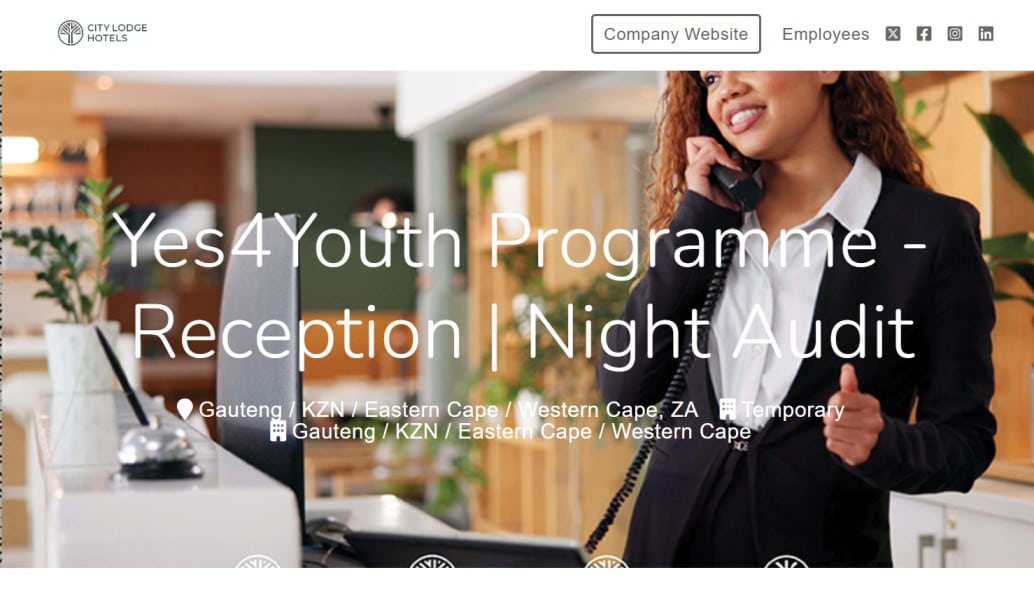
City Lodge Yes4Youth Programme – Reception: Night Audit

City Lodge Yes4Youth Programme - Reception: Night Audit

City Lodge Yes4Youth Programme – Reception: Night Audit

Location: Gauteng / KZN / Eastern Cape / Western Cape, ZA

Closing Date: Rolling

Yes4Youth paid employment programme: 12-month contract.

Educational Requirements:

Grade 12 Certificate.

Hospitality Diploma advantageous.

Experience: Front Office / Reception experience advantageous.

Scope & Purpose:

To undertake all Reception and / or Night Audit functions and other duties as required by Management. To welcome and register guests on arrival. Answer telephones and deal with queries and requests. Check guests out on departure. To take reservations and sell rooms and complete various aspects of front office administration as directed. To ensure that courteous and efficient service is provided to guests and suppliers in line with the Company’s vision, values and fundamentals.

Applicants must be between the ages of 20 – 34.

Special Conditions:

This job requires prolonged sitting, walking and standing, working in awkward and static postures, performing repetitive movements, exposure to psychosocial and cognitive stressors, manual handling, pushing and pulling of loads, managing fatigue due to irregular hours, frequent role transitions that contribute to visual strain, and tasks that may result in hearing strain.

About City Lodge South Africa

City Lodge Hotel Group is a proudly South African hospitality company that began in 1985 with the opening of City Lodge Hotel Randburg, now known as City Lodge Hotel Bryanston. The JSE-listed group has grown into one of Southern Africa’s leading hotel operators, with properties in South Africa, Botswana, Namibia and Mozambique. Its portfolio includes four brands: Courtyard Hotel, City Lodge Hotel, Town Lodge and Road Lodge, allowing the group to serve luxury, business, leisure and budget-conscious travellers.

Each City Lodge brand is designed for a different type of guest. Courtyard Hotel offers an upscale experience, while City Lodge Hotel provides comfortable upper-midscale accommodation for business and leisure travellers. Town Lodge focuses on practical, contemporary stays, and Road Lodge provides affordable accommodation for travellers who want convenience and value for money. Many of the group’s hotels are positioned near airports, business districts, shopping centres, transport routes and major attractions, making them useful for both short visits and longer stays.

City Lodge hotels typically provide services such as free Wi-Fi, parking, 24-hour reception, restaurants, meeting facilities, swimming pools, gardens, fitness rooms and laundry services, depending on the property. Beyond accommodation, the group contributes to South Africa’s tourism and hospitality sector through employment, training, supplier development and support for small businesses. City Lodge also offers career opportunities in areas such as hotel management, front-desk services, housekeeping, food and beverage, maintenance, finance and administration, making it a notable employer within the country’s hospitality industry.

HOW TO APPLY

CLICK HERE TO APPLY

Sasol is Hiring Four(4) Entry Level Administrators in Sasolburg

Bosch South Africa Graduate Trainee Programme – Human Resources

Bosch South Africa Graduate Trainee Programme - Human Resources

Bosch South Africa Graduate Trainee Programme – Human Resources

Location: 33 Piet Rautenbach St, Brits, 0250, South Africa

Closing Date: Rolling

Company Description

Do you want beneficial technologies being shaped by your ideas? Whether in the areas of mobility solutions, consumer goods, industrial technology or energy and building technology – with us, you will have the chance to improve quality of life all across the globe. Welcome to Bosch.

Job Description

Robert Bosch (Pty) Ltd is seeking a recently qualified graduate to be mentored in Human Resources, hosted within our Human Resources Department. The successful applicants will gain practical experience and mentorship across the following key areas:

Payroll

  • Assist with processing payroll data and maintaining accurate employee records
  • Support salary calculations, deductions, and statutory compliance requirements
  • Maintain payroll documentation and ensure data integrity
  • Respond to employee payroll-related queries under supervision

Training and Development

  • Support the coordination and delivery of training programes
  • Coordinate training schedules, resources, and participant records
  • Support performance management and employee development initiatives

Qualifications

Requirements 

  • Completed Matric / Grade 12 
  • Degree or diploma in Human Resources/Industrial Psychology or any other relevant Degree/Diploma

Additional Information

By choice, we are committed to a diverse workforce and are an equal opportunity employer. Robert Bosch welcomes and encourages applications from people with disabilities. Accommodations are available on request for candidates taking part in the selection process.

About Bosch South Africa

Bosch South Africa forms part of the Bosch Group, a global technology and services company with operations across mobility, industrial technology, consumer goods, and energy and building technology. In South Africa, Bosch is known for products and services such as automotive components, vehicle technology, power tools, household appliances, building technology, packaging technology, and heating solutions. The company’s local operations support both consumers and businesses through technology designed to improve efficiency, safety, convenience, and quality of life.

Bosch has an office in Midrand, Gauteng, where several divisions and technical functions are based. These include Automotive Aftermarket, Building Technology, Household Appliances, Packaging Technology, Power Tools, and Thermotechnology. Bosch also operates a high-tech manufacturing facility in Brits, North West, which produces automotive parts for original-equipment manufacturers and the aftermarket sector. The company has also established training facilities focused on automotive technical skills and power tools.

Career opportunities at Bosch South Africa cover areas such as engineering, manufacturing, sales, information technology, human resources, finance, technical support, and project management. The company offers opportunities for students, graduates, interns, and experienced professionals, including programmes designed to build specialist and leadership skills. For South Africans interested in technology, manufacturing, automotive systems, and engineering, Bosch provides a platform to gain practical experience while contributing to innovative products and services used locally and internationally.

HOW TO APPLY

CLICK HERE TO APPLY

BREAKING: R37 Million PESP 7 Programme Opens for Applications – NFVF Calls on Creatives to Apply

Sasol is Hiring Four(4) Entry Level Administrators in Sasolburg

Sasol is Hiring Four(4) Entry Level Administrators in Sasolburg

Sasol is Hiring Four(4) Entry Level Administrators in Sasolburg

Location: Sasolburg

Closing Date: 12 October 2026

Sasol is a global integrated chemicals and energy company with a 75-year heritage. Through Sasol talented people, Sasol uses its expertise and selected technologies to safely and sustainably source, manufacture and market chemical and energy products globally. When you join Team Sasol, you are joining a company that puts people at the center of everything the company does.

Sasol invests in its employees along every stage of the career path and offers development opportunities to help you cultivate your career in a culture that embraces diversity and inclusion.

Purpose of Job

To organize day-to-day operations; perform various administrative tasks and provide administrative support to assigned teams.  To coordinate all administrative processes and activities to ensure the teams activities run smoothly.  To avail the provision of high-quality service to team members

Key Accountabilities

  • Providing administrative services to ensure effective and efficient operations.
  • Responsible for general area / department and is the team’s expert in methods and tasks efficiencies.
  • Facilitate the workflow of managers and immediate team members by managing diaries.
  • Maintaining hard copy electronic files and records so they remain updated and easily accessible.
  • Planning and co-ordination of appointments, meetings and maintain calendar.
  • Liaising with colleagues and external contacts to book travel and accommodation.
  • Arranging both in-house and external events such as conferences, meetings, and travel reservations for office personnel.
  • Attends meetings, write effective meeting minutes and distribution thereof.
  • Supports the team with filing and administration duties.
  • Compose letters, memorandum, develops charts, graphs, and diagrams.
  • Prepare materials for workshops, conferences, meetings, duplicates/collates and distribution.
  • Ensures the office “building” is well maintained, reporting all deviations and follow up.
  • Optimize and control resources cost effectively within budget.
  • Ensure performance and quality of internal capabilities.
  • Maintains files and financial records, attendance reports, leave records, trip records and logs Proofreads and edits documents.
  • Logs IT and operational problems/requests on behalf of the team and ensures that they are resolved.
  • Maintains databases, distribution lists and organograms for the team.
  • Maintains and processes forms and monitors and controls the management team leave schedules.
  • Co-ordinates and implements office procedures and frequently has responsibility for specific projects and tasks.
  • Greets visitors and callers, handles their inquiries, and directs them to the appropriate persons according to their needs.
  • Answers telephone, takes messages and answers inquiries within assigned scope of responsibility.
  • Manage work planning and delivery according to timelines.
  • Serve stakeholders through quality information, service solutions and value creation.
  • Provide efficient and high-quality services to internal and external customers

Formal Education

Grade 12 / National Senior Certificate

Working Experience

Minimum 3 years relevant experience

Required Personal and Professional Skills

  • TC_Document Management
  • BC_Communicates Effectively
  • TC_Action Planning
  • BC_Manages Complexity
  • BC_Plans and Aligns
  • BC_Drives Results
  • TC_Office Administration
  • TC_Planning and Organisation
  • BC_Ensures Accountability
  • TC_Multi-tasking

About Sasol South Africa

Sasol is a South African-founded global chemicals and energy company with a major role in the country’s industrial economy. The company develops and uses specialised technologies to produce products such as liquid fuels, chemical components, gas, polymers, solvents, ammonia, methanol, bitumen and other industrial materials. Sasol operates internationally, but its Southern African activities remain central to its business, including large-scale operations in Secunda and Sasolburg.

In South Africa, Sasol’s operations include mining, gas, fuels and chemicals. Its Energy business manages fuel marketing and sales, gas sourcing and distribution, fuel blending, storage, logistics and related energy solutions. The company supplies products to households, businesses, transport operators and industrial customers, while its chemicals activities support sectors such as manufacturing, agriculture, construction, packaging and consumer goods. Sasol’s facilities and supply chains also support employment, technical skills development and economic activity in several communities.

Sasol is also under pressure to reduce the environmental impact of its operations, which account for approximately 10% of South Africa’s greenhouse-gas emissions. The company has set a target of reducing Scope 1 and 2 emissions by 30% by 2030 and has an ambition to reach net-zero emissions by 2050. Its plans include improving energy efficiency, increasing renewable-energy use, exploring lower-carbon feedstocks, developing green hydrogen opportunities and expanding renewable-energy capacity. These commitments are important as Sasol works to balance energy security, industrial production, economic development and South Africa’s transition to a lower-carbon economy.

HOW TO APPLY

CLICK HERE TO APPLY

SBV South Africa Unemployed Banking Learnership: Cash Processor Contractor

Border Management Authority (BMA) is Looking for a Health Specialist: R964 058 – R1 178 293 Per Annum

Border Management Authority (BMA) is Looking for a Health Specialist: R964 058 - R1 178 293 Per Annum

Border Management Authority (BMA) is Looking for a Health Specialist: R964 058 – R1 178 293 Per Annum

Location: Airport Industria

Closing Date: 01 October 2026

The BMA is established as an armed service in terms of Section 199(3) of the constitution, a third in the country in addition to the South African National Defence Force (SANDF) and the South African Police Service (SAPS) through the Border Management Authority Act No 2 of 2020. The Border Management Authority invites suitable candidates to apply for the following vacant position.

Job Description

The successful candidates will be expected to perform the following duties:

Specialised Health Services

  • Ensure implementation of IHR (2005) in ports of entry.
  • Develop and ensure implementation of Core Capacity requirements for points of entry.
  • Support ports of entry in implementing the core capacity action plans.
  • Provide reports on the status of implementation of core capacity action plans.
  • Ensure effective implementation of relevant Port Health related legislation, policies and guidelines in ports of entry.
  • Comment and provide input on port health draft legislation, policies, norms and standards, guidelines and standard operating procedures.
  • Co-ordinate the implementation of control measures and management protocols for emerging and re-emerging diseases in respect of international travellers within the Region.
  • Facilitate and support the development of public health contingency plans at ports of entry within the Region.
  • Support effective provision of port health services at the ports of entry within the Region.
  • Ensure compliance to South African & International legislation of all imported health related goods.
  • Ensure proper health control measures at a Regional level to prevent and manage diseases at the ports of entry.
  • Improve processes related to port health management that take place within the Border Law Enforcement Area and at ports of entry related to domestic and international trade obligations.

Management of staff and Resources

  • Provide technical support to staff in ports of entry.
  • Develop and implement human resource development and training programmes for officials and ensure planned and organised orientation and induction of new staff.
  • Convene performance review and management meetings with ports of entry within the Region.
  • Provide financial planning and guide control of port of entry budget.
  • Implement financial control measures for the Health Specialist function.

Data Analysis and Information Management 

  • Ensure data management, monitoring and evaluation, and research and administrative functions, for the effective provision of port health management in the BMA.
  • Develop Regional operational plan and ensure implementation.
  • Provide monthly and quarterly data as per the national DHIS indicators.
  • Facilitate the management and verification of health-related record keeping.
  • Monitor the cost recovery for shipping related activities.
  • Use insights gained through business information to compile reports, and metrics to measure success and inform the business decision making process and realign objectives.

Stakeholder Management and Relations 

  • Provide advocacy on port health related matters to relevant stakeholders.
  • Actively participate in relevant border management structures;
  • Represent the Health Specialised functions on matters pertaining Port Health operations on various structures.
  • Engage various internal and external stakeholders on the signing of memorandums of understanding for services to be provided.
  • Collaborate with the necessary organs of state, domestic and international organisations to promote and enhance effective, efficient and secure goods and human movement.
  • Ensure the development and effective stakeholder relations management with both local and international communities in support of national objectives
  • Build and maintain effective internal and external stakeholder relationships for the purpose of expectations management, knowledge sharing and integration.
  • Lead the identification and mitigation of internal systems and procedural barriers to enhance excellent customer service.
  • Lead the implementation of timeous communication on relevant information and legislation to the Ports of Entry.
  • Participate in industry related forums, conferences and workshops.

Risk and Compliance 

  • Keep abreast of changes in legislation, regulations and respond to changes through adjustments to the strategy and operational plans as required.
  • Ensure submission of mandatory reports and information.
  • Ensure the mitigation of the business units’ risk profile through the application of fraud controls and risk prevention principles and implementing of sound governance and compliance processes and tools to identify and manage risks.
  • Assist in the establishment, maintenance and improvement of Standard Operating Procedures, policies, and guidelines relating to the business unit in consultation with the Executive Manager.
  • Monitor changes in the regulatory environment and ensure that appropriate operational controls are implemented to address new requirements.
  • Ensure effective support in the provision of evidence to all internal and external audit requirements.
  • Adhere to all relevant laws, policies and Standard Operating Procedures throughout the organisation.

Knowledge 

  • Knowledge of the South African Constitution.
  • Knowledge of the Border Management Authority Act.
  • Understanding of International and Regional Protocols, agreements & treaties
  • Knowledge of Environmental Health and Port Health matters
  • Knowledge of the control of communicable diseases
  • Understanding of the Aviation and Maritime Industry requirements.
  • Understanding of legislation and prescripts applicable in the border environment.
  • Knowledge and understanding of the port security risks in relation to port health, immigration, biosecurity and environmental risk.
  • Knowledge of the National Treasury and Risk Management Framework.
  • Knowledge of the Public Service Act and Regulations as well as the Public Finance Management Act.

Professional registration

  • Current registration with the Health Professions Council of South Africa (HPCSA) as an Environmental Health Practitioner in the category Independent Practice

Job Requirements

Minimum requirements

  • Grade 12
  • Undergraduate Qualification at NQF level 7 recognized by SAQA in Environmental Health.
  • Postgraduate at NQF Level 8 in Public Management or Public Administration will be added as advantaged
  • Minimum of 5 years’ relevant experience in Specialist / Professionals Port Health Services 
  • Flexibility in working hours and extensive travel will be required to meet the demands of the role.
  • May be required to work overtime.
  • Valid driver’s License.

The BMA is an equal opportunity employer committed to employment equity and workforce diversity preference may be given to suitably qualified candidates from designated groups in line with the BMA employment equity plan. The BMA reserves the right not to make an appointment to the advertised positions. It is the applicant’s responsibility to have all foreign qualifications evaluated by South African Qualification Authority (SAQA) and to confirm the appropriate NQF level and to provide proof of such evaluation report. It is the applicant’s responsibility to have all foreign qualifications evaluated by South African Qualification Authority (SAQA) confirm the appropriate NQF level and to provide proof of such evaluation.

  • Shortlisted candidates may be subjected to an interview and technical assessment (s) which assesses the candidate’s demonstrated professional and technical competency against the job requirements and duties).
  • Candidates potentially considered suitable after the interview and technical test(s) for senior positions, will be subjected to a competency assessment (which tests the candidate’s demonstrated proficiency in the professional dimensions attached to the level of the post):
  • Employment suitability check will be conducted on the shortlisted candidates (credit, criminal, citizenship, employment references and qualification verifications):
  • Appointment will be subjected to a mandatory vetting/security clearance appropriate to the level of the position.

Closing Date: 01 October 2026

About The Border Management Authority (BMA) South Africa

The Border Management Authority (BMA) is a South African national public entity responsible for managing and securing the country’s borders and ports of entry. Established under the Border Management Authority Act of 2020, the BMA was created to bring together frontline border-control functions that were previously handled by several government departments and agencies. It became operational in April 2023 and is overseen by the Minister of Home Affairs.

The BMA facilitates the legitimate movement of people and goods while carrying out frontline border-law-enforcement responsibilities. Its work includes immigration control, access control at ports of entry, port health, agricultural and environmental biosecurity, food safety, phytosanitary inspections, border-risk management, and the prevention of illegal migration, smuggling, trafficking, and cross-border crime. The Authority operates across South Africa’s land, air, and maritime ports of entry and coordinates with other law-enforcement and government institutions.

The BMA plays an important role in balancing national security with the need to support legal travel and trade. South Africa has dozens of land, airport, and seaport entry points, making effective coordination essential for protecting the country while allowing authorised travellers, businesses, and goods to move efficiently. Through its integrated approach, the BMA aims to improve border security, reduce delays, strengthen information-sharing, protect public health and the environment, and contribute to South Africa’s economic development.

HOW TO APPLY

CLICK HERE TO APPLY

BREAKING: R37 Million PESP 7 Programme Opens for Applications – NFVF Calls on Creatives to Apply

Schneider Electric Sales Apprentice Program: Hybrid Work Model

Schneider Electric Sales Apprentice Program: Hybrid Work Model

Schneider Electric Sales Apprentice Program: Hybrid Work Model

Location: Hybrid, South Africa

Closing Date: Rolling

Job Description

The Schneider Electric Sales Apprentice Programme is designed to provide unemployed graduates and early career professionals (18-35 years) with practical workplace experience in sales, customer engagement and business development within the Home Solutions business.

The programme combines structured learning with on-the-job experience, equipping participants with the skills required to build a successful career in sales and customer-facing commercial roles.

Sales Apprentices will learn how to:

  • Prospect and identify new sales opportunities
  • Build customer relationships
  • Promote Schneider Electric Home Solutions products
  • Generate leads and sales pipeline
  • Conduct product demonstrations
  • Support channel and retail partners
  • Manage customer enquiries
  • Utilize CRM tools and sales processes
  • Develop commercial and negotiation skills

Key Responsibilities

Prospecting & Business Development

  • Identify and engage potential customers.
  • Generate qualified sales leads.
  • Conduct cold calling and customer outreach activities.
  • Build and maintain a sales pipeline.

Customer Engagement

  • Visit customers and channel partners.
  • Understand customer needs and recommend solutions.
  • Deliver product presentations and demonstrations.
  • Maintain strong customer relationships.

Sales Support

  • Assist with quotations and sales proposals.
  • Support promotional campaigns and activations.
  • Track opportunities using CRM tools.
  • Follow up on customer enquiries.

Learning & Development

  • Participate in structured sales training.
  • Complete all learning assignments.
  • Demonstrate application of learning in the field.
  • Maintain professional standards and company values.

Success Profile

The ideal Sales Apprentice is someone who Is ambitious, energetic and eager to build a career in sales. They enjoy meeting new people, are comfortable initiating conversations, can handle rejection positively and are motivated by achieving results. They demonstrate strong learning agility, customer focus and a passion for technology and energy management solutions.

Minimum Qualification Requirements

Essential

Applicants must:

  • have completed a related commerical or technical National Diploma or Undergraduate Degree at a registered institute in South Africa
  • Be a South African citizen
  • Between 18 and 35 years of age
  • Unemployed and not currently participating in another learnership or internship programme
  • Valid driver’s licence advantageous
  • Willingness to travel
  • Basic Microsoft Office skills
  • Good verbal and written communication skills

About Schneider Electric South Africa

Schneider Electric South Africa is part of the global Schneider Electric group, a technology company focused on energy management, industrial automation, electrification, and digitalisation. The company helps businesses, industries, buildings, data centres, utilities, and homes use energy more efficiently, safely, and sustainably. Its solutions combine connected electrical products, automation systems, software, digital services, and technical expertise.

In South Africa, Schneider Electric provides integrated solutions for several sectors, including power and utilities, mining, manufacturing, commercial buildings, data centres, infrastructure, and renewable energy. Its services include energy monitoring, industrial automation, electrical distribution, cybersecurity, asset management, smart metering, and digital transformation. Through platforms such as EcoStruxure, the company helps customers connect equipment, monitor performance, identify inefficiencies, and make better operational decisions.

Schneider Electric also contributes to South Africa’s sustainability and skills-development efforts. Its local sustainability strategy focuses on decarbonisation, digital transformation, responsible resource use, ethical business, and inclusive growth. The company has also supported technical education and Industry 4.0 skills development through initiatives such as its partnership with Eastcape Midlands TVET College, which established an electrical laboratory to help prepare students for careers in electrification, automation, and digital technologies.

HOW TO APPLY

CLICK HERE TO APPLY

SANParks Admin Tourism Service Excellence Ambassador (BSP) Programme: R400 a day salary

BREAKING: R37 Million PESP 7 Programme Opens for Applications – NFVF Calls on Creatives to Apply

Opens for Applications - NFVF Calls on Creatives to Apply

BREAKING: R37 Million PESP 7 Programme Opens for Applications – NFVF Calls on Creatives to Apply

Breaking news for South Africa’s film and television sector: The National Film and Video Foundation (NFVF) has opened applications for Project 1 of the Seventh Presidential Employment Stimulus Programme, known as PESP 7. The programme is focused on the audio-visual industry and is designed to support employment, production, skills development, marketing, and distribution. Applications opened on 22 September 2026 and close on 5 October 2026. The NFVF has warned that the deadline will not be extended because the programme must be implemented within the 2026/27 financial year.

Although the programme has been widely discussed as a R37 million opportunity, applicants should read the official NFVF call carefully because it sets out the approved streams, funding limits, job-creation targets, eligibility requirements, and submission process. This is not an open invitation to submit any creative idea. It is a targeted opportunity for projects that fall within the audio-visual industry and meet the specific requirements of the relevant stream.

What is PESP 7?

The Presidential Employment Stimulus Programme is a government initiative intended to create work opportunities and support economic recovery. The NFVF has been tasked by the Department of Sport, Arts and Culture (DSAC) with administering the audio-visual component of PESP 7.

The programme comes at a time when many South African creatives are working project to project, struggling to secure production finance, or trying to build sustainable careers in an industry that requires expensive equipment, specialised skills, and strong networks.

PESP 7 aims to help address some of these challenges by supporting projects that create employment while contributing to South Africa’s film, television, video, and broader audio-visual ecosystem.

The NFVF’s call includes three main streams under Project 1:

  • Production.
  • Skills development and training.
  • Marketing and distribution.

The online application portal also specifies that the production stream is limited to short-format projects. The marketing and distribution stream includes eligible film festivals, film markets, and public screenings. Projects that fall outside the defined scope may not be considered.

Who should pay attention?

This opportunity may be relevant to:

  • Film and television production companies.
  • Audio-visual companies.
  • Producers.
  • Directors.
  • Production managers.
  • Writers and development teams.
  • Training providers in the creative sector.
  • Film-festival organisers.
  • Film-market organisers.
  • Public-screening organisers.
  • Companies with suitable short-format production proposals.
  • Creative businesses that can demonstrate employment creation.

However, do not assume that every individual creative can apply directly for every stream. The application portal makes important distinctions between calls. For example, the Youth Filmmaker Project Facilitating Company call is specifically for companies, and only Tier 1 and Tier 2 companies can apply. That means applicants must first identify the correct call and confirm whether the applicant must be an individual, a company, or another qualifying entity.

The three application streams

Stream 1: Production

The production stream is focused on short-format audio-visual projects. The NFVF’s published funding table indicates a cap of up to R400,000 for the production and post-production stream.

This could be relevant to a company proposing a short film, short documentary, short-form series, or another eligible audio-visual project. But applicants should not simply submit a creative idea. The proposal must show:

  • What the project is about.
  • Who the intended audience is.
  • Why the project matters.
  • How it will be produced.
  • Who will be employed.
  • What the production budget covers.
  • Where filming will take place.
  • How the project will be delivered.
  • What post-production work is required.
  • How the project will meet the NFVF’s requirements.

For example, a production company might propose a short documentary series highlighting young township entrepreneurs. A strong application would explain the concept, episode structure, production schedule, crew, target audience, distribution plan, budget, and number of paid jobs that would be created.

A weak application would simply say:

We want R400,000 to make a film about young people.

The second version is too vague. It does not tell the panel what will be made, who will benefit, or how the money will be used.

Stream 2: Skills development and training

The skills-development stream is intended to support training and capacity-building initiatives in the audio-visual sector. The NFVF’s published funding range is between R700,000 and R1 million for this stream.

A suitable project might train unemployed youth in:

  • Camera operation.
  • Sound recording.
  • Editing.
  • Production management.
  • Scriptwriting.
  • Animation.
  • Visual effects.
  • Lighting.
  • Set design.
  • Digital distribution.
  • Film business management.
  • Production safety.
  • Archiving and preservation.

A training proposal should go beyond saying that it will “empower young people.” It should explain:

  • How many participants will be trained.
  • Who qualifies to participate.
  • What skills they will learn.
  • How long the training will last.
  • Who will deliver the training.
  • What equipment will be used.
  • Whether participants will receive practical experience.
  • How participants will be assessed.
  • How many jobs or work opportunities will be created.
  • What support will be available after training.

For example, a company might propose a six-month editing programme for 60 unemployed young people in the Eastern Cape. The proposal could include classroom training, practical editing assignments, workplace exposure, mentorship, and a plan to place successful participants on paid productions. That is more convincing than listing a training topic without showing how the programme will produce real employment outcomes.

Stream 3: Marketing and distribution

The marketing and distribution stream focuses on eligible projects such as film festivals, film markets, and public screenings. The published funding cap is between R500,000 and R1.5 million.

This stream may suit an organisation that wants to:

  • Host a film festival.
  • Operate a film market.
  • Organise public screenings.
  • Promote South African audio-visual content.
  • Connect filmmakers with buyers and distributors.
  • Develop audiences in underserved communities.
  • Take local films to regional or international markets.

An applicant should clearly explain the audience, location, programme, participating filmmakers, marketing strategy, venue arrangements, expected attendance, distribution partners, and employment opportunities.

For example, a public-screening proposal could take South African short films to rural communities that have limited access to cinemas. The project might employ local coordinators, technical crews, facilitators, translators, and marketing assistants. It could also include discussions with filmmakers and workshops for young people. That kind of proposal shows both cultural value and employment potential.

The amount is not the only thing that matters

Headlines about millions of rands naturally attract attention, but the value of an opportunity should not be judged only by the total allocation. What matters to applicants is:

  • Whether they qualify.
  • Which stream applies to them.
  • The maximum amount available.
  • The number of jobs expected.
  • The type of project accepted.
  • The submission deadline.
  • The required documents.
  • The project completion period.
  • The organisation’s capacity to deliver.

The NFVF’s call sets out separate budget amounts for the three streams, appeals, administration, and a digitisation project. It states that DSAC allocated R178.1 million for the wider 2026/27 PESP 7 implementation, with a target of 12,000 jobs. Project 1’s production, skills-development, marketing, and distribution streams account for specific portions of that allocation.

This is why applicants should avoid using a headline amount as though every applicant will receive an equal share. Funding is competitive and subject to the official assessment process.

Who may not qualify?

The official NFVF announcement states that individuals employed by government departments, entities, municipalities, and other services are not eligible to participate in the programme.

Applicants should also check:

  • Whether the application is open to individuals or companies.
  • Whether the organisation falls within the required tier.
  • Whether the proposed project is audio-visual.
  • Whether the project is within the eligible format.
  • Whether the project is based in South Africa where required.
  • Whether the applicant can meet the job-creation requirements.
  • Whether the applicant has the necessary registration and compliance documents.

Do not assume that having a creative idea automatically makes you eligible.

How to apply

The NFVF has instructed applicants to register and complete the online application form through its application platform:

NFVF PESP 7 application portal

The portal provides access to the relevant NFVF application calls and indicates the submission dates and times. For Project 1’s three streams, the application window is listed as 22 September to 5 October 2026.

Before starting the online form:

  1. Read the official NFVF call in full.
  2. Identify the stream that fits your project.
  3. Confirm whether you are applying as an individual or company.
  4. Check the eligibility criteria.
  5. Prepare your project proposal.
  6. Prepare your budget.
  7. Gather supporting documents.
  8. Register on the platform.
  9. Complete every required section.
  10. Submit before the deadline.
  11. Save proof of submission.

Do not wait until the final afternoon. Online systems can become busy, and you may discover that a document is missing or that your proposal requires more detail.

What should be in your proposal?

The exact requirements may differ by stream, so always use the official application guidelines. In general, your proposal should answer the following questions:

What are you proposing?: Describe the project in plain language. A reader should understand it without needing to guess.

Who is the audience?: Explain who will watch, attend, use, or benefit from the project.

Why is the project important?: Discuss its creative, social, cultural, educational, or economic value.

Who will be employed?: List the roles that will be created. Include production crews, trainers, administrators, technical teams, facilitators, marketers, and other relevant workers.

How long will it take?: Provide a realistic timeline from preparation to completion.

How will the money be used?: Break down the costs clearly. Avoid a budget that contains only one large amount with no explanation.

Can you deliver the project?: Provide evidence of relevant experience, partnerships, previous work, staff, equipment, or technical capacity.

What happens after funding?: Explain how the project will reach audiences, continue generating work, create future opportunities, or strengthen the creative ecosystem.

A practical example

Imagine a small production company based in the Free State. It wants to apply for the production stream with a short documentary about young agricultural entrepreneurs.

Its application should explain:

  • The documentary’s title and concept.
  • Why youth agriculture matters.
  • The communities and entrepreneurs to be filmed.
  • The director, producer, camera operator, sound technician, and editor.
  • The production schedule.
  • The equipment required.
  • The post-production plan.
  • The expected duration.
  • The audience.
  • The distribution plan.
  • The number of paid jobs created.
  • The total budget and each major cost.

A proposal that shows thought and planning gives the assessors a clearer basis for evaluation. The company does not need to promise unrealistic numbers. It needs to provide a credible plan and demonstrate that it understands what is required.

Avoid these application mistakes

Choosing the wrong stream: A project aimed at a feature film may not fit a call focused only on short formats. Read the scope carefully.

Applying as the wrong type of applicant: Some calls are only for companies or certain company tiers. Do not register as an individual if the call requires a qualifying company.

Submitting an incomplete form: An unfinished online application may not be considered. Review every section before final submission.

Using an unrealistic budget: Do not inflate costs simply because a maximum amount is available. Explain each cost and connect it to the project.

Forgetting employment outcomes: PESP is an employment-stimulus programme. Explain how the project will create paid work or meaningful employment opportunities.

Submitting late: The NFVF has stated that late applications will not be accepted and that the closing date will not be extended. Treat 5 October 2026 as a firm deadline.

Confusing the email addresses: The NFVF announcement states that application queries should be directed to PESP@NFVF.CO.ZA, not APPLICATIONS@NFVF.CO.ZA. Use the correct address for questions and consult the official call for submission instructions.

Copying someone else’s proposal: A copied application may fail to reflect your real capacity or project. Write in your own words and provide accurate information.

Information sessions

The NFVF’s published announcement says that online information sessions and question-and-answer sessions are scheduled for 28 to 30 September 2026, with details and joining links to be shared on the NFVF website and social-media platforms. These sessions may be useful if you are uncertain about:

  • Eligibility.
  • Stream selection.
  • Application requirements.
  • Company tiers.
  • Project formats.
  • Budgets.
  • Supporting documents.
  • Employment targets.
  • Technical submission issues.

Prepare your questions before attending. If the answer affects your application, write it down and check whether the same information appears in the official written guidelines.

Protect yourself from scams

Whenever a major funding opportunity is announced, scammers often appear. Remember:

  • Do not pay anyone who guarantees approval.
  • Do not share your application password.
  • Do not send your banking PIN or one-time password.
  • Do not use a link forwarded by an unknown person.
  • Verify information through the NFVF’s official website.
  • Keep copies of your application and supporting documents.
  • Be cautious of people claiming to be NFVF officials through personal accounts.

The official application portal should be your main route for registration and submission. If you have a question, use the NFVF contact information published in the official call.

This is about more than one application

For some creatives, PESP 7 may be the opportunity that allows a project to move from an idea to a completed production. For others, it may support training that helps unemployed young people enter the film and television industry. For festivals, markets, and screenings, it may create a platform for South African work to reach new audiences.

But funding is not a substitute for preparation. A creative idea needs a practical plan. A production needs people, a budget, a schedule, and a distribution strategy. A training programme needs competent trainers and a route from learning to work. A festival needs audiences, venues, marketing, and reliable administration.

Take the opportunity seriously. Read the call, prepare early, submit accurately, and keep proof of everything you do.

Conclusion

The NFVF has opened an important opportunity through the PESP 7 Programme, but the deadline is close and the application requirements must be taken seriously. If you are a qualifying South African creative, production company, training provider, festival organiser, or audio-visual business, check the correct stream, prepare a credible proposal, and apply through the official NFVF portal before 5 October 2026 at the stated closing time. Do not wait until the final day.

For more opportunities beyond the creative industry, visit Careers South Africa. The platform shares daily job updates, internships, learnerships, apprenticeships, scholarships, online courses, and practical job tips for South African youth. Following Careers South Africa can help you discover the next opportunity, improve your CV, prepare for interviews, and stay informed about programmes that can turn your skills into real work.

Breaking Record: NSFAS Received Over 51,000 Applications in 4 Days of 2027 Application Cycle – Apply Today

SBV South Africa Unemployed Banking Learnership: Cash Processor Contractor

SBV South Africa Unemployed Banking Learnership: Cash Processor Contractor

SBV South Africa Unemployed Banking Learnership: Cash Processor Contractor

Location: Nelspruit

Closing Date: Rolling

Key Performance Areas (KPA’s)

Receive Cash

•Receive deposits and update on the applicable systems.
•Comply with all policies and procedures to eliminate any possible risks to the company and the customer.

Prepare Cash on the applicable system

•Check container/Bag for any damages or interferences and report all anomalies to Team Controller.
•Acknowledge container/bag on applicable system.
•Process all deposits in line with the agreed upon banks SLAs and SOPs on the applicable system.
•Prep workstation accurately for effective and efficient note counting.

Note Sorting

•Sort all prepped deposits/notes for (FDP/ACDP) on the same day, within the cut off times.
•Send rejected notes to the Reject Teller together with the PCD cards, deposit slips and stop loss bag to verify and balance
•Operator to write a board (client name, date, denominations & number of bundles & operator name) & show it to the camera.
•Balance per deposit
•Report differences to the Team Controller
•Fill the production sheet
•The technician to sign the downtime register on machine breakdowns
•End of day bundles to be verified by Team Controller.
•Daily balancing\reconciliation by Team controller

Reconciliation of ACDP deposits

•Perform a reconciliation of all notes rejected in order to validate the information
• Manually check all rejected notes for counterfeits, dye-stained and mutilated notes
• Perform cash transfers to vaults
• Perform end of day balancing/ reconciliation of all cash received
• Handle all transactions including shortages and surpluses according to SOPs

Desktop deposit processing

• Check container/Bag for damage /tamper, report anomalies to Team Controller.
• Acknowledge container/bag on applicable system.
• All deposits must be kept separate per customer at all times and all deposits must be processed on the same
   day received by the customer.
• All deposits must be processed and balanced on the applicable system
• Perform end of day balancing/ reconciliation of all cash received
• All transactions, including shortages and surpluses must be handled according to SOPS
• Accurate prepping must be done to enable effective and efficient note counting

Sachet and Process Coin

• Process bulk coin deposits in accordance with SBV’s policies and Procedures
• Sort and process teller coin transfers
• Write a board (client name, date, denomination and the operator names) & show it to the camera
• Receive and verify the money(bins), check the seal, denomination and bin register
• Count out the bags to balance with the bin page and denomination
• Cut the bags open to fill the wagon
• Clear jams on the machines
• Balance the money per client / deposit
• Report differences to the Team Controller
• Perform end of day balance/ reconciliation

Bank system integrated deposit processing

• Validate all transactions linked to system integrations as per banks SLA
• Inform client services of account numbers not linked to bank system to avoid delays in crediting the customer
• Verify deposit account number to eliminate losses or misposts
• Escalate system downtime/delayed batches to team controller

Payroll and change

• Payroll / change transactions must be processed in accordance with SLA per customer
• Report all discrepancies to the Team Controller timeously
• Floats must be sealed in drop safe bags along with float packing slips and placed into trolleys as per client
   requirement
• Payroll entries to be processed within the banks SLA timeframes
• Maintain all equipment by reporting any defects on equipment to the Team Controller
• Obtain banks authorization prior to despatching as per SOP

Prepack/Treasury

• Assist with the accurate packing and unpacking of Bank and ATM Cash.
• Manage consumables in line with packing requirements.
• Confirm that the bag and Seal numbers are properly recorded.

Manage Equipment

• Utilise equipment according to Standard Operating Procedures (SOPS), protecting and taking care of company
assets, e.g. cleaning of the machines before the shift starts and after the shift ends

Governance

• Subscribe and align to SBV Services’ ISO 9001:2015 Quality Management Standards, ensuring the
   department’s processes and quality management system is at all times in compliance with the standard.
• Support SBVs ESG journey, reporting on and managing the ESG requirements to ensure a positive reflection
   and outcome.

Drive the organisation culture

• Drive the department’s values while inspiring confidence and generating excitement, enthusiasm and
   commitment towards the mission.

Lead as an Ambassador and executor of Change

• Act as a change management architect in periods of change to ensure business continuity.
• Manage the integration of business units into a seamless end to end solution for customers.
• Effectively communicate and embed new processes and procedures as they occur, addressing or escalating
   matters/ concerns to the SME’s (subject matter experts) when required.
• Facilitate the necessary presentations, workshops, or forums to ensure consistent and accurate
   communication is given across one’s portfolio.

Requirements

Minimum Requirements:

  • Not participated in the National Certificate: Banking previously
  • Grade 12 with Math’s /Literacy
  • Age 18-29

About SBV South Africa

SBV Services is a South African company that provides secure cash-management and security solutions to the banking and commercial sectors. Founded in 1986, SBV operates across the cash value chain, helping collect, process, store, transport, and distribute cash safely. The company also serves clients in Namibia and Lesotho and works with central and commercial banks in the region.

SBV’s services include cash-in-transit operations, cash processing, ATM management, coin management, retail cash-deposit processing, cash-centre management, and the secure movement of banknotes and coins. The company operates more than 25 processing centres, uses over 600 armoured vehicles, and employs thousands of people across its operations. It also serves as an approved carrier for the central bank and acts as a custodian for certain off-site cash vaults.

Because cash remains important to many South African businesses and communities, SBV plays a significant role in keeping money moving safely through the economy. Its work supports banks, retailers, businesses, ATM networks, and customers by ensuring that cash is available where it is needed while reducing the risks associated with handling and transporting valuable assets. As a registered security service provider, SBV combines logistics, technology, risk management, and trained security personnel to protect cash throughout the supply chain.

HOW TO APPLY

CLICK HERE TO APPLY

SANParks Admin Tourism Service Excellence Ambassador (BSP) Programme: R400 a day salary