
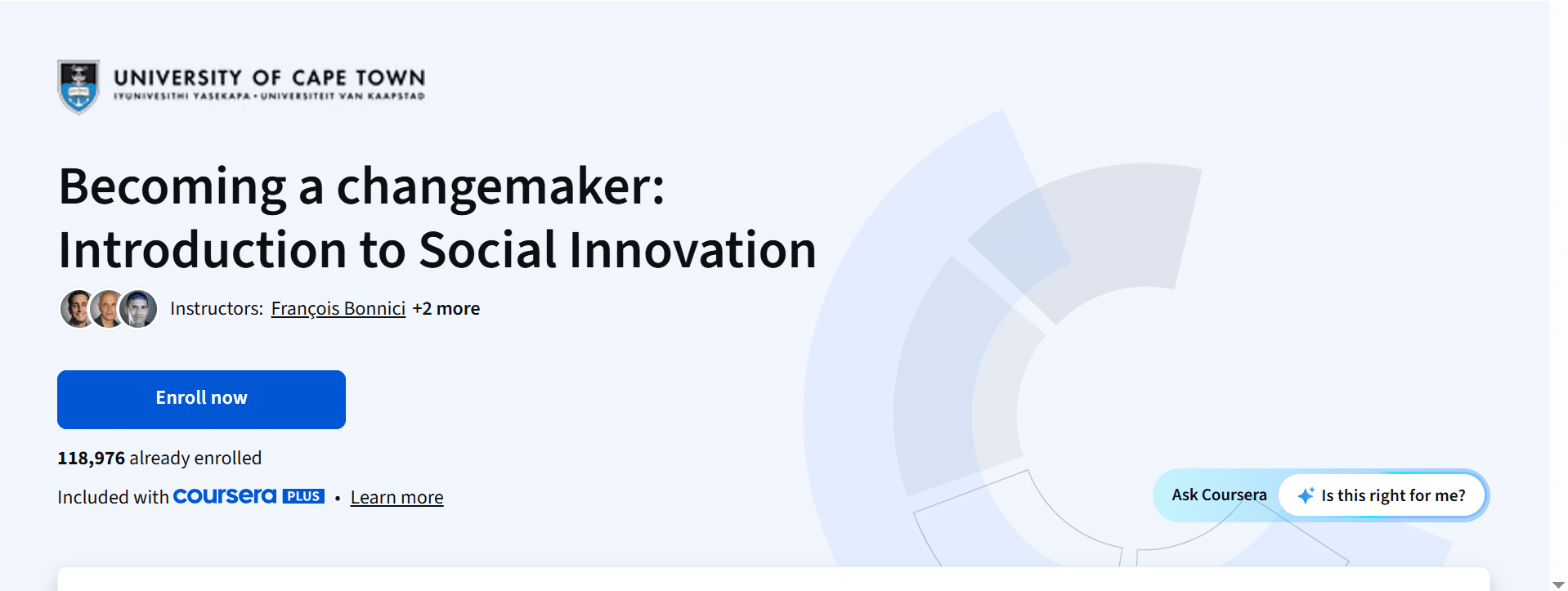
UCT Free Online Course on Becoming a changemaker: Introduction to Social Innovation

UCT Free Online Course on Becoming a changemaker: Introduction to Social Innovation

Location: Online

Closing Date: Ongoing

What you’ll learn in this UCT Coursera Online Course?

  • How to develop the concepts, mindset, skills, and relationships needed to start becoming a changemaker.
  • How to form your own approach to social innovation and identify resources to begin acting as a social innovator.

There are 6 modules in this course

This online course is for anyone who wants to make a difference. Whether you are already familiar with the field of social innovation or social entrepreneurship, working for an organization that wants to increase its social impact, or just starting out, this course will take you on a journey of exploring the complex problems that surround us and how to start thinking about solutions.

We will debunk common assumptions around what resources are needed to begin acting as a social innovator. We will learn from the numerous examples of social innovations happening all over the world. You will be challenged to get out of your comfort zone and start engaging with the diverse spaces around you. By the end of the course, you will have formed your own approach to social innovation, and you will have begun to develop the concepts, mindset, skills, and relationships that will enable you to start and evolve as a changemaker.

The Bertha Centre for Social Innovation and Entrepreneurship co-created this course with RLabs, a social movement ‘born-and-bred’ in Bridgetown, Cape Town that is now active in 22 countries. The movement empowers youth through innovative and disruptive technology by teaching them vital skills and providing much needed support and a sense of community. Advocating and supporting initiatives such as RLabs forms part of the Bertha Centre’s mandate. The Centre is a specialised unit at University of Cape Town’s Graduate School of Business, and is the first academic centre in Africa dedicated to advancing social innovation and entrepreneurship.

Module 1: What’s our problem

Welcome! We being by distinguishing between simple, complicated and complex problems. Social innovation takes place in complex systems and complex systems have complex or “wicked” problems. These are the kinds of problems the world is trying to tackle right now such as climate change, HIV Aids and other pandemics, poverty and inequality. A complex system has many variables or elements such as different people, materials and rules. These are all interacting with each other so much that the complexity increases exponentially. So the work of complexity is about bringing yourself into the system, engaging with it, living with it and innovating in yourself as you innovate in that system that you’re working in. You can’t look at the whole system but you can look at more than one piece of it. The more you start to bring in different parts of the systems, you can then start to connect those in ways that they weren’t connected before.

Module 2: What do we have to work with?

One of the hallmarks of very innovative organizations and people is that they see resources where other people don’t, and they can bring those resources to bear to create new innovative solutions. There’s transformative power in shifting from looking at needs, gaps, and what’s wrong, to appreciating strengths, resources and what’s right. Through developing a strength-based mindset and an appreciative approach you can discover hidden or underused resources. These resources might be people, kinds of knowledge and expertise, time, and physical spaces. As soon as you start seeing resources all around you, not only can you move forward but you become energised and hopeful, and creative things start to happen. You’ll find that you might be a lot richer than you think in terms of what you have to start building your own social innovation with.

Module 3: Getting out of your comfort zone

By nature the world of social innovation is made of crossing boundaries, bringing together different actors, resources, spaces, but it can be overwhelming. Part of our challenge on the journey to becoming changemakers is to learn how to become comfortable with discomfort and how in the social innovation space where you take yourself into spaces and you surround yourself with people that you normally do not engage with. Understanding how we define differences using cultural, sociological, psychological and spiritual lenses and what the nature of the differences is helps to develop tools for getting out of your comfort zone. It takes a little bit of courage because it makes you uncomfortable, but that’s how you build the competencies, the personal resilience to engage with difference when we do go and drive for innovations or we look to make differences in communities that are unlike us or operate in a different way.

Module 4: Innovation by design

A number of methodologies and processes can help generate ideas and creative opportunities, and some of these have been used in business to generate new products and services, and are starting to be applied in social innovation. Human-centred design is incredibly important, and the Design Thinking process allows you to start early and wherever you are with whatever you’ve got. Design Thinking has evolved as a way to respond to deeper user insights, to connect more with people and with communities so that we can actually design solutions that are human-centred. Design Thinking is not just about products, but also helps create new processes, new systems, new services, and importantly even user experiences. Following a Design Thinking process will help you iterate and test your solution with end users, with an emphasis on failing early and often through trying things out and prototyping. Powerful Design Thinking methodology can help you to come up with human-centred design solutions that manifest economic viability, technical feasibility and social desirability in your social innovation.

Module 5: Changing the system – who me?

Understanding that social innovation is system innovation can help us appreciate why social innovation is so difficult to do. Social innovations can start to challenge and change the underlying system conditions that caused the social or environmental problem in the first place. We are asked to innovate around belief systems, or around authority, power, and resource flows. So, a social innovation challenges the rules of the game. Asking what’s innovative about the work means asking questions around the experiences of where an innovation might be changing the rules of the games and allows us to go deeper into the kinds of impacts that might be possible, and discover hidden impacts. When any kind of social innovation starts to get at the systemic roots, we’re going to be provoking anxiety. So it’s quite helpful to map out the social system and the rules that govern it and then to consider how you are challenging these rules through the innovation.

Module 6: What if it works?

In the end social innovation is about impact. We’re all trying to have a meaningful, positive effect on the world, whatever that might mean to us. If we do this and we’re actually successful, this is going to take us sooner or later to the question of scale. How do we grow that innovation? As social innovations mature, the forms they could take and the multiple ways in which you could organise around achieving impact increase. It used to be easy to label organisations according to non-profit and for profit, and government institutions based on their purpose, its organisational structure and the way it measured what it achieved. That’s all changing. There are different ways to diffuse and scale the work that we’re doing to achieve impact.


HOW TO ENROLL

ENROLL HERE

Which Online Courses Can Help You Land a Good Paying Job?

Which Online Courses Can Help You Land a Good Paying Job?

Hey there, friend. Let me sit you down for a moment and talk to you like I would talk to my own younger cousin sitting across the kitchen table. I’ve been where you are, staring at job boards, feeling that mix of excitement and anxiety about the future, wondering if you’re doing the right things to build a career that doesn’t just pay well but actually makes you feel proud when you clock out at the end of the day.

I’ve worked in hiring, I’ve interviewed hundreds of people, and I’ve also been the person on the other side of the table, taking online courses at 2 a.m. while juggling a full-time job, because I knew I needed to level up. Through all of that, I’ve learned something crucial: the right online course can absolutely be your ticket to a good-paying job, but you have to pick the right one and, more importantly, know how to use it.

This isn’t about college degrees being dead or online courses being magic. This is about being smart about your time, your money, and your future. Let me walk you through what actually works, with real stories from people I’ve met along the way.

The Reality Check: What Employers Actually Look For

Before we dive into specific courses, let me tell you something that might surprise you. When I’m hiring for a US$70,000+ position (annual salary or Rands equivalent), I don’t start by asking “What degree do you have?” I start by asking “What can you actually do?” and “Can you prove it?”

A few years ago, I hired a computer support specialist who’d never been to college. She had a Google IT Support Certificate and a portfolio of troubleshooting logs she’d created during her training. She could explain technical problems in plain English, she showed up early, and she solved problems faster than half the people with bachelor’s degrees in my network. She’s now a senior systems administrator making $95,000.

The key isn’t the certificate itself—it’s what you can demonstrate you’ve learned. That’s why I’m going to focus on courses that give you hands-on skills, real projects, and sometimes even industry connections.

Tech and IT: The Most Reliable Path to High Pay

If I had to bet on one category that consistently lands people in good-paying jobs, it’s technology. Not because tech is “sexy”—but because businesses run on technology now, and they need people who can keep the lights on.

1. Google IT Support Professional Certificate (Coursera)

What it teaches you: Basic computer troubleshooting, operating systems, networking, security, and customer service skills.

Real salary range: $50,000–$75,000 for entry-level IT support roles

Why this works: This certificate is recognized by employers because it’s practical. You’re not memorizing theory—you’re actually fixing things. I’ve seen people go from working retail to IT support in three months with this.

Real-life example: Meet Marcus. He was working at a grocery store in Atlanta, making $14 an hour. He was good with computers in his head but had no formal training. He spent $49/month on Coursera, took the Google IT Support certificate over four months while working part-time shifts, and landed his first IT job at a hospital. Two years later, he’s a cloud support engineer at $88,000. His wife just told me last month they’re looking at buying their first house.

“The course didn’t just teach me tech—it taught me how to think like someone who solves problems. That’s what got me hired.” — Marcus

2. Google Data Analytics Professional Certificate (Coursera)

What it teaches you: Data collection, cleaning, analysis, visualization with tools like SQL, R, and Tableau.

Real salary range: $60,000–$90,000 for data analyst roles

Why this works: Data is everywhere now. Every company has data, and most of them don’t know how to use it properly. This course teaches you how to find patterns and tell stories with numbers.

Real-life example: Priya Sharma, a marketing coordinator in India, was stuck in a role that paid barely above minimum wage. She had a passion for understanding customer behavior but no technical skills. She took the Google Data Analytics certificate over six months, built three portfolio projects analyzing real customer data sets, and applied to data analyst positions. She got three interviews and landed a job at a fintech startup in Bengaluru. Within two years, she moved to a senior role at $75,000.

What Priya did differently: She didn’t just complete the course. She uploaded her projects to GitHub, wrote blog posts explaining her analysis, and linked everything in her resume. Employers could see her work before they even interviewed her.

3. AWS Certified Cloud Practitioner (Amazon Web Services)

What it teaches you: Cloud computing fundamentals, AWS services, security, and pricing models.

Real salary range: $70,000–$110,000 for cloud roles

Why this works: Cloud computing is the backbone of modern tech. Companies are moving everything to AWS, Azure, and Google Cloud, and they need people who understand how to manage it.

Real-life example: Rahul Verma started his career as a data entry operator at a small firm. He was bored, underpaid, and knew he needed to change. He enrolled in an AWS certification program, studied for four months, and passed the Cloud Practitioner exam. That certificate got him an interview at an IT firm. He wasn’t the most experienced candidate, but he knew cloud architecture better than anyone else in the room. He got the job as a junior cloud associate at $62,000. Three years later, he’s a senior cloud engineer at $115,000.

Digital Marketing: Where Creativity Meets Business

Not everyone wants to be coding. Some people are better at talking to humans, understanding what they want, and selling to them. That’s where digital marketing comes in.

4. HubSpot Content Marketing Certification (Free)

What it teaches you: Content strategy, writing for different channels, SEO basics, and measuring content performance.

Real salary range: $45,000–$70,000 for content marketing roles

Why this works: Content is still king. Every business needs someone who can write blog posts, create social media content, and make sure their website shows up in Google searches.

Real-life example: Priya Sharma (the digital marketing one, different from the data analyst Priya) had a passion for writing but couldn’t pursue full-time courses because of family responsibilities. She took HubSpot’s free content marketing certification, started freelancing on weekends, and within three months landed her first job as a Digital Marketing Executive at $52,000. Today, she runs her own agency and works with international brands. Her first client? A small business in the UK that she found through LinkedIn.

My advice if you go this route: Don’t just take the course. Start a blog. Write about what you’re learning. Build a portfolio. Employers in marketing care more about what you’ve created than what certificate you have.

5. Google Analytics 4 Certification (Free)

What it teaches you: How to track website traffic, understand user behavior, and measure marketing campaign performance.

Real salary range: $50,000–$75,000 for marketing analytics roles

Why this works: Every company with a website needs someone who can tell them how many people are visiting, where they’re coming from, and what they’re doing. This certification makes you that person.

Business and Finance: The Stable, High-Paying Crew

If tech feels too technical and marketing feels too creative, business and finance might be your lane. These fields are less flashy but consistently pay well and offer stability.

6. Coursera Business Finance Certificate

What it teaches you: Financial statement analysis, budgeting, capital budgeting, and investment decisions.

Real salary range: $55,000–$80,000 for financial analyst roles

Why this works: Finance is the backbone of every organization. If you understand how money flows through a business, you can work in almost any industry.

Real-life example: Sonal, a stay-at-home mom from Mysore, wanted to start an eco-friendly gift brand but had no business knowledge. She completed a B.Com online degree, which gave her foundational finance and branding skills. Within months, she launched her startup. She credits her online education with giving her the confidence to execute her plans.

7. HubSpot Social Media Marketing Certification (Free)

What it teaches you: Social media strategy, content creation, audience engagement, and analytics.

Real salary range: $40,000–$65,000 for social media roles

Why this works: Every brand needs Instagram, TikTok, and LinkedIn presence. Companies are hiring people specifically to manage these channels.

Healthcare Support: The Quiet Goldmine

Healthcare is one of the most stable industries, and you don’t need to be a doctor to work in it. There are tons of support roles that pay well and require certifications you can get online.

8. Medical Records Specialist Certification (various providers)

What it teaches you: Patient data management, healthcare coding, privacy regulations (HIPAA), and database systems.

Real salary range: $45,000–$65,000

Why this works: Hospitals and clinics need people to manage patient records. This is a behind-the-scenes job, but it’s stable, pays well, and’s not going away.

Real-life example: Kamla from Jharkhand couldn’t travel to a university for the programs she wanted. After joining an online BCA, she studied from home, gained a recognized degree in Software Development, and eventually got a role at a fintech startup in Bengaluru—all without leaving her home state.

9. Paralegal Certificate (Coursera/UC Berkeley)

What it teaches you: Legal research, contract drafting, civil procedure, and ethics.

Real salary range: $50,000–$70,000

Why this works: Law firms need paralegals to handle research, draft documents, and manage cases. It’s a stepping stone to law school if you want to go that route later.

The Skills That Actually Get You Hired (Beyond the Certificate)

Now let me tell you the part most people skip. The certificate alone won’t get you hired. Here’s what does:

Build a Portfolio

Don’t just complete the course. Create something with what you learned. If you took data analytics, analyze a real dataset and publish it. If you took marketing, write blog posts and show your writing. If you took IT, document troubleshooting scenarios you’ve solved.

Tell Your Story

When I interview someone, I want to know why they’re here. Did you take this course because you’re curious? Because you’re trying to escape a job that’s burning you out? Because you want to build something for your family? That story matters.

Network, Even Quietly

Join LinkedIn groups related to your field. Comment on posts. Share what you’re learning. You don’t need to be loud—you just need to be present.

Get Experience, Even If It’s Free

Volunteer to help a local business with their social media. Offer to analyze data for a nonprofit. Do freelance work on Upwork. Three months of real experience is worth more than five certificates.

The Hard Truths You Need to Know

Let me be real with you for a minute.

1. Not all certificates are equal. A Google certificate is recognized. A random certificate from a website you found on Google probably isn’t. Invest in courses from reputable providers: Coursera, Udemy, LinkedIn Learning, HubSpot, AWS, Google.

2. You’ll need to keep learning. The certificate gets you in the door. Your ability to keep learning keeps you there. Tech changes fast. Marketing changes fast. Finance changes. Stay curious.

3. Your first job might not be the dream job. Marcus started at $50,000. Priya started at $52,000. They’re both at $90,000+ now. Your first job is about getting experience, not hitting your salary ceiling.

4. Some fields require more than a certificate. If you want to be a doctor, engineer, or lawyer, you still need degrees. But for IT, data, marketing, and business support, certificates can absolutely work.

5. You have to apply even when you’re scared. I’ve seen people take courses, feel unqualified, and never apply. Don’t do that. You’re more qualified than you think.

My Personal Recommendation for Where to Start

If I’m 22 years old again, with no degree and trying to figure out where to start, here’s what I’d do:

  1. Take the Google IT Support Certificate (3–4 months)
  2. Apply for IT support jobs while working your current job
  3. Once hired, learn AWS or cloud skills on the side
  4. Move into cloud engineering within 2–3 years

This path is the most straightforward, has the highest success rate, and gets you to $70,000+ fastest.

If tech doesn’t feel right, go with Google Data Analytics. It’s slightly more competitive but still has tons of opportunities, and you can work in any industry.

Final Words: You’re Not Alone in This

I know this feels overwhelming. I know you’re scrolling through job boards at night, wondering if you’ll ever make it. I know you’re comparing yourself to people who seem to have it all figured out.

But let me tell you something: most people don’t have it figured out. They’re just figuring it out in public while you’re figuring it out in private.

The people who succeed aren’t the smartest. They’re the ones who:

  • Take the course even when they’re tired
  • Apply for jobs even when they’re scared
  • Keep learning even when they’re not sure it’s working
  • Show up consistently, even when no one’s watching

You can do this. I’ve seen it happen. I’ve been part of it happening. And I’m going to keep seeing it happen because the right course, the right skills, and the right mindset can change your life.

Pick one course from this list. Start it this week. Complete it. Build something with what you learn. Apply for jobs. And when you get that first offer, come back and tell me. I’ll be here, ready to celebrate with you.

You’ve got this.

If you found this helpful, share it with someone who’s trying to figure out their next step. And if you’re going through this right now, drop a comment below. Tell me what course you’re thinking about taking. I read every one.

ALSO CHECK: Nine CV Mistakes Costing You Job Interviews in South Africa – Check And Correct

Enroll in this Best FREE Online Artificial Intelligence Course: AI Marketing – Everything Done Online

Enroll in this Best FREE Online Artificial Intelligence Course: AI Marketing - Everything Done Online

In this free online course, learn to leverage on recent AI technologies in building effective marketing strategies.

AI Marketing explores integrating artificial intelligence into modern strategies. Learn to leverage AI for consumer analysis, optimise campaigns, and personalise experiences. This course covers machine learning, chatbots, and ethical considerations. Gain practical insights into AI’s transformative impact on market research, segmentation, and the dynamic landscape of digital marketing, providing a skill set for capitalising on AI for marketing.

What You Will Learn In This Free Online Course

  • Compare the different AI tools for marketing and their various uses and applications
  • Define AI marketing and ascertain its modern-day uses in different industries and businesses around the globe
  • Identify the key concepts in AI marketing as well as the gradual evolution of AI in the marketing world
  • Recognise diverse ways AI can be used for customer relationship management and possible future applications
  • Discuss the personalisation and targeting of the desired audience using AI in order to achieve desired results
  • Analyse customer behaviour using predictive analysis and apply AI-driven content creation and optimisation
  • State methods for using AI in search engine optimisations and its various applications in the industry

“AI Marketing” is an online course designed to empower participants with the knowledge and skills needed to leverage artificial intelligence (AI) in marketing. This comprehensive course explores the seamless integration of AI into modern marketing strategies. Participants will delve into the practical application of AI tools, including machine learning algorithms, for in-depth consumer analysis, campaign optimisation, and personalised customer experiences. The course covers the implementation of chatbots for enhanced customer engagement and explores AI-driven content creation.

Ethical considerations in AI marketing are addressed, providing a well-rounded understanding of responsible AI usage. Through real-world case studies and practical examples, participants gain insights into AI’s transformative impact on market research, segmentation, and the overall digital marketing landscape. The course emphasises staying at the forefront of industry trends, preparing individuals to navigate the evolving synergy between AI and marketing effectively.

Whether professionals are looking to enhance their digital marketing skills, stay competitive in the job market, or embark on a career in AI marketing, this online course equips them with the expertise to harness the power of AI in driving successful marketing campaigns and staying ahead in the rapidly evolving digital era.

Emirates Group is Hiring for Cabin Crew Members in Different Provinces of South Africa

About AI Marketing

AI marketing uses machine learning, predictive analytics, and natural language processing to automate critical decisions, analyze customer data, and deliver hyper-personalized campaigns. It enables businesses to scale content creation, forecast consumer behavior, and optimize ad spending at speeds that are impossible to achieve manually.

Adopting AI fundamentally changes how marketing teams operate by shifting the focus from manual guesswork to data-driven, scalable strategies.

Core Capabilities and Use Cases of AI Marketing

  • Content Generation: Using tools to draft email copy, social media posts, and landing page variations at scale.
  • Predictive Analytics: Forecasting purchasing behavior, customer retention, and customer lifetime value based on past interactions.
  • Hyper-Personalization: Using data models to recommend products dynamically and serve tailored messages to individual buyers.
  • Automated Ad Management: Continuously monitoring campaign performance and shifting ad budgets in real time to maximize Return on Investment (ROI).
  • Chatbots & Virtual Assistants: Handling customer inquiries instantly and routing complex tickets to human agents.

The Benefits of AI integration in marketing. Implementing AI in your marketing stack offers several key advantages:

  • Increased Efficiency: Automates repetitive tasks (like data analysis and formatting), allowing human teams to focus on high-value creative and strategic planning.
  • Better Targeting: Identifies high-value customers by recognizing behavioral traits and mapping exact points in the purchasing funnel.
  • Scalability: Handles complex, multi-channel marketing efforts (email, video, paid media) across large audiences without needing proportional increases in staff.

HOW TO ENROLL NOW

Click on the link below in order to see how you can register and enroll for this free online course on AI Marketing.

ENROLL HERE

Become A Pro By Enrolling to this Introduction to Data Analysis Free Online Course

Become A Pro By Enrolling to this Introduction to Data Analysis Free Online Course

Introduction to Data Analysis

Learn how to effectively manage and improve your business using data analysis tools in this free online course.

This free online data analytics certification teaches you about the principles of process management, tools for data analysis, and how to measure performance in your business environment. This course will focus on four basic tools of data analysis that everyone working in an organization should know and you will study strategies in dealing with variations, as well as how to structure your business area and use data to improve performance.

What You Will Learn In This Free Online Course

  • Discuss strategies to deal with special and common cause variations
  • Identify data performance tools like the Pareto chart, histogram, run chart, and control chart
  • Explain the structures of performance management
  • Differentiate between the “voice of the customer” and the “voice of the people”
  • Describe how to use data to drive improvement in your business
  • Explain special cases where the method for creating a control chart changes

This free data analytics course will focus on four basic tools of data analysis that every data analyst should be familiar with. The course starts by giving you an overview of the main agenda, and the definition of a process. You will then study the three strands of effective management with reference to Brian Joiner Deming’s book “Fourth Generation Management” as groundwork for the next part which teaches you to analyze your customers and review some questions to ask yourself when dealing with a customer. The first set of principles of process management will be outlined in this section and you will be taught how to understand how each of your business processes operates in its current condition. The steps involved in Deming’s chain reaction will be explained relating it to the second set of principles of process management. Teamwork is the next theme and this data analytics training covers how to work as one team and take responsibility for mistakes and setbacks to improve the “process.”

This data analytics certificate program then discusses the dangers of bad data reporting as well as the principles of good data analysis. You will also be given a comprehensive run-through on four performance data tools for data analysis to act as a filter to identify areas where you need further and deeper analysis. The first is the Pareto Chart which is a special type of histogram used to arrange categories from the highest frequency to lowest. The second tool is the histogram which is used to show the range of performance. Then, the Run Chart, which shows data over a time period. And lastly, there is the Control Chart. You will be taught how to interpret the control chart and see special cases where the method for creating the control chart changes will be highlighted. Exercises with actual walkthroughs and solutions using all four data analysis tools will be provided.

Your learning then includes being introduced to the nature and principles of variation in process performance and the ways to determine the performance of a business process by measuring the background levels of the business. This comprehensive data analytics education program explores strategies for dealing with special and common cause variations. The following key theme practically teaches you how to use data to drive meaningful improvement in your businesses and the correct way to add value or enhance the value of your products and services to appeal to customers will be explained. Towards the end of the course, you will be taught how to define a problem and analyze the current situation in your business. This free data analytics course will be well suited for data analysts, business managers, accountants, or anyone interested in using data to improve the performance of their business, so enrol today and add the in-demand skill of data analysis to your portfolio so you can open more career opportunities.

Online Course Modules

Module: Introduction to Data Analysis
Module: Course assessment

How TO REGISTER / APPLY

Click on this link to register and enroll for this free online course.

Most Important!

Follow us on our Social Media Handles to remain connected to daily opportunities:

Facebook: https://www.facebook.com/careerssouthafrica/

Linkedin: https://www.linkedin.com/company/careers-south-africa-za/

WhatsApp Group: https://chat.whatsapp.com/JVphaaPQEOU9VBlpVJAtIi?mode=gi_t

WhatsApp Channel: https://whatsapp.com/channel/0029Vb7gAx5J3jupoQfCwt2n