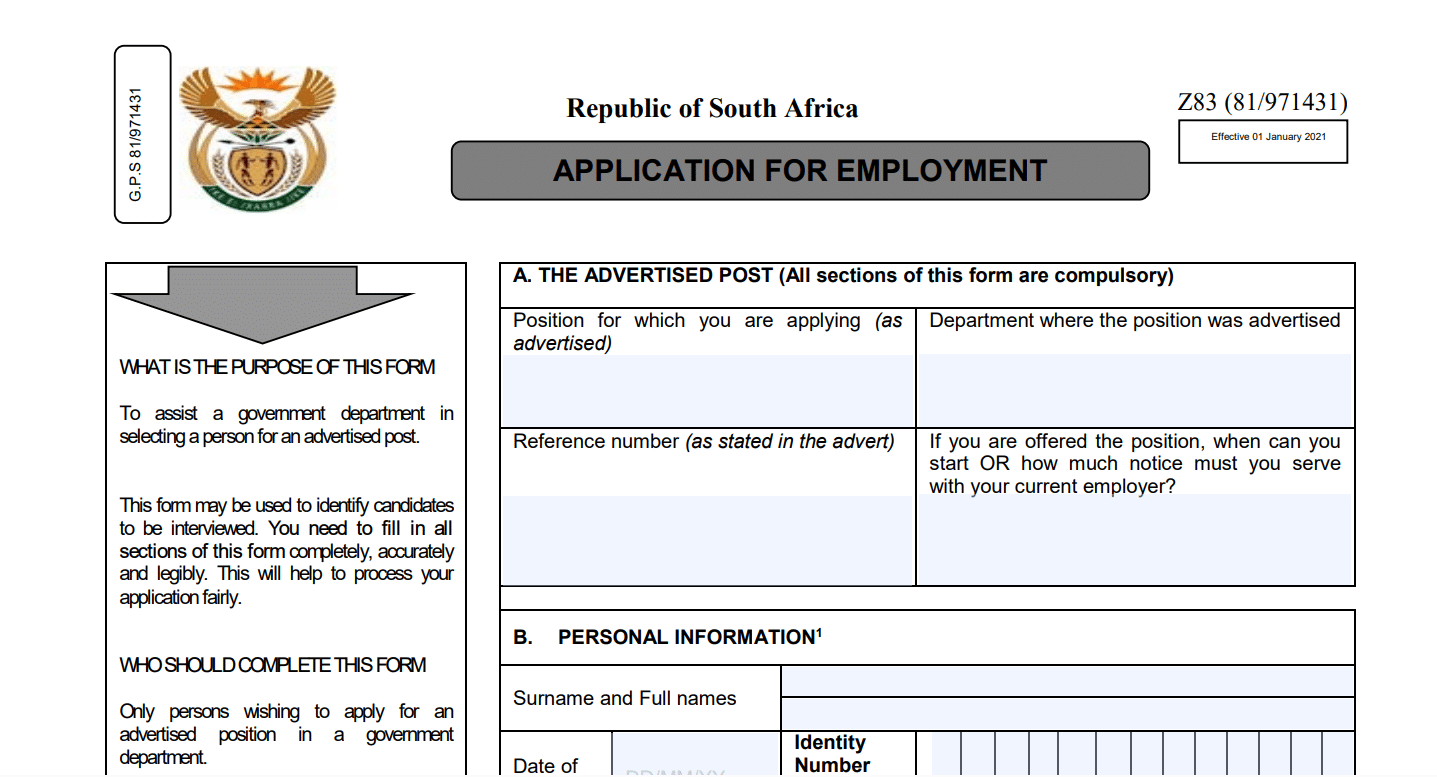
If you’ve ever tried to apply for a government job, an internship, or a learnership in South Africa, chances are someone has told you “just fill in the Z83 form.” Sounds simple enough, right? Except then you go online, you Google it, and suddenly you’re staring at two or three different versions of what’s supposed to be the same form. One is old and the other looks sleeker, has more boxes to tick, and asks you things the old one never did. Now you’re sitting there wondering: which one do I actually use? And more importantly, will using the wrong one cost me the job before a human even reads my CV?
This is the exact confusion this post is here to clear up. We’re going to walk through, in plain language, exactly what changed between the old Z83 and the new Z83 form, why the change happened in the first place, and what it means for you as a young South African chasing your first real opportunity, whether that’s an internship, a learnership, or a full graduate position inside the public service. By the end of this, you won’t just know the difference – you’ll understand it well enough to explain it to your friend who’s also job hunting.
First Things First: What Even Is The Z83?
Before we compare old versus new Z83 form, let’s back up for a second, because not everyone reading this grew up with a parent who worked in government or had a career counsellor walk them through this stuff.
The Z83 form is officially called the “Application for Employment” form. It is the standard form used across almost every national and provincial government department in South Africa whenever they advertise a vacancy. Whether it’s a cleaner’s post at a rural clinic or a director’s post at head office in Pretoria, the very first document the hiring panel looks at is your Z83. Not your CV. Not your qualifications. The Z83 comes first, and it sets the tone for everything else in your application.
Think of it like the bouncer at the door of a club. Your CV, your certificates, your ID copy; those are all the good stuff you brought to the party. But if the bouncer at the door doesn’t like your outfit (in this case, an incomplete or incorrect Z83), you’re not even getting past reception, no matter how impressive the rest of your application is.
This is why so many capable young people, people who are genuinely qualified and would do a fantastic job, get knocked out in the very first round. Not because they weren’t good enough for the position, but because they didn’t fill in a form correctly, or worse, they used the wrong version of that form entirely.
So Why Did The Z83 Even Change?
For years, the old Z83 form did the job it needed to do. It collected your basic details, your work history, your references, and asked you to declare a few things about criminal records and previous public service employment. It wasn’t a bad form. But the Department of Public Service and Administration, commonly known as the DPSA, decided it needed an update, and there were a few honest reasons behind that.
Public service hiring in South Africa has, for a long time, faced criticism around transparency. There have been cases of people being appointed to positions despite undisclosed conflicts of interest, undisclosed business dealings with the state, or hidden disciplinary history from previous government jobs. The old form simply didn’t dig deep enough into these areas. So the DPSA gazetted a new, more detailed version of the Z83, and this new form officially came into effect on 1 January 2021, after being approved and published in the Government Gazette on 6 November 2020.
That’s actually the exact document you referenced; the editable, approved new Z83 form as gazetted on 6 November 2020. It’s the version every government department in the country is legally required to use today. If you’ve been sent a link to that PDF, congratulations, you already have the correct, current form in your hands.
The Real Differences: Old Z83 Versus New Z83
Now let’s get into the meat of it. What actually changed between the two versions? This is where a lot of blog posts online get a little vague, so let’s be specific.
1. A Much Deeper Dive Into Personal Information
The old form asked for your basic personal details, the kind of thing you’d expect: your name, ID number, contact details, race and gender for employment equity purposes, and whether you had a disability. The new form kept all of that, but it expanded significantly on the questions around your history and your integrity as a potential public servant.
On the new form, under Section B, “Personal Information,” you’re now required to answer a whole series of yes-or-no questions that weren’t nearly as prominent, or in some cases didn’t exist at all, on the older version. These include:
- Whether you’ve ever been convicted or found guilty of a criminal offence, including an admission of guilt
- Whether you have a pending criminal case against you
- Whether you’ve ever been dismissed for misconduct from the Public Service specifically
- Whether you have a pending disciplinary case against you
- Whether you resigned from a job while disciplinary proceedings were pending against you
- Whether you’ve ever been discharged or retired from the Public Service on grounds of ill health, or on condition that you cannot be reappointed
- Whether you are conducting business with the State, or are a director of a company that does business with the State
That last point about business interests is a big one, and it’s really at the heart of why the form changed. The new Z83 wants to know upfront if you, or a company you’re linked to, might have a conflict of interest with the very department you’re applying to work for. If the answer is yes, you’re also asked whether you’d be willing to immediately relinquish those business interests if you’re appointed.
2. A Formal Declaration You Physically Sign And Initial
The old form had a signature section too, but the new form makes a much bigger deal out of it, and for good reason. Every page of the new Z83 must be initialed by you, and the form now includes a clear, formal declaration statement at the very end that reads something close to: “I declare that all the information provided, including any attachments, is complete and correct to the best of my knowledge. I understand that any false information provided will result in my application being disqualified, or disciplinary action being taken against me if I am appointed.”
This might sound like just legal wording, but treat it seriously. If you tick “No” to a question about a pending disciplinary case and it later comes out that you weren’t honest, this isn’t just a case of your application being thrown out. If you were already appointed by the time it comes to light, that declaration is what allows the department to take disciplinary action against you, or even terminate your employment. Young job seekers sometimes think of the Z83 as “just admin,” a box-ticking exercise standing between them and the real interview. It isn’t. Treat it with the same seriousness you’d treat a legal contract, because in many ways, that’s exactly what it is.
3. Formal Qualifications Section Now Wants More Structure
Under the old form, your education history was often squeezed into a fairly small, generic section. The new form, under Section E, “Formal Qualification,” specifically asks you to list your qualifications from highest to lowest, along with the name of the school or technical college, the qualification obtained, and the year you obtained it. It also now includes a separate line asking about your current study, meaning the institution and qualification you’re currently working toward, even if you haven’t finished it yet.
This matters a lot for young people, particularly matriculants and current students. If you’re still studying toward a diploma or degree, don’t leave that blank just because you haven’t graduated yet. The new form specifically gives you space to show that you’re currently building your qualifications, which can genuinely work in your favour for internships and learnerships aimed at students and recent graduates.
4. Certification Of Documents: A Small Change That Makes A Big Difference
Here’s one of the more practical differences, and it’s one that trips a lot of people up. Under the old system, in a lot of cases, applicants were expected to send in certified copies of their ID, qualifications, and other supporting documents right from the very first application.
The new Z83 changed the rhythm of this slightly. The special notes on the current form state that departments must accept certified documents that accompany the application with certification that is up to six months old, unless the specific advert says otherwise. In practice, what this generally means for you is that once you are shortlisted, you’ll typically be asked to bring or submit certified original copies of your documents at that stage, so the certification stays fresh and relevant closer to the point of actual verification.
The lesson here isn’t “don’t worry about certified copies.” The lesson is: read the specific advert carefully every single time, because government departments can and do specify exactly what they want attached at the point of application versus what they want later. Never assume. The Z83 gives general guidance, but the individual vacancy advert is where the department tells you exactly what they expect from you for that particular post.
5. Layout, Structure, And Length
Purely on a visual level, if you place the old and new forms side by side, the new one is noticeably more structured. It’s broken into clearly labeled sections from A through G:
- Section A covers the advertised post itself — the position, the department, and the reference number
- Section B covers your personal information, including all those integrity-related questions we covered above
- Section C covers your contact details and preferred medium of communication
- Section D covers your proficiency in South African official languages
- Section E covers your formal qualifications
- Section F covers your work experience, and specifically instructs you to also attach a detailed CV
- Section G covers your references
This letter-by-letter structure isn’t just for looks. It makes it much easier for HR officials to scan through hundreds, sometimes thousands, of applications and quickly locate exactly the information they need. It also makes it easier for you, the applicant, to double check that you haven’t accidentally skipped a section, because each one is clearly boxed off and labelled.
Why Using The Old Form Can Cost You The Job
Let’s talk honestly for a second, because this is the part that matters most if you’re currently job hunting.
Since 1 January 2021, the old Z83 form has not been valid for any government vacancy. If you download an old copy from some random website, fill it in perfectly, attach a beautiful CV, and submit it for a position, in most departments that application will be disqualified automatically, often before a single human being even reads your qualifications. It doesn’t matter how strong your matric results were, how relevant your diploma is, or how much experience you’ve picked up through volunteering or part-time work. If the form itself is outdated, the system, or the HR official doing the initial sort, is very likely to set it aside.
This is genuinely heartbreaking when you think about it, because it means young people who are otherwise perfectly capable are losing out on life-changing opportunities over something as fixable as downloading the correct PDF. So here’s the golden rule, and it’s worth repeating because it really is that important: always download your Z83 form fresh, directly from the official DPSA website, every single time you apply. Don’t reuse a copy you saved on your laptop three months ago. Don’t trust a random blog’s attached PDF without checking it against the official source first. Government forms can be updated, and the only way to be one hundred percent sure you have the right one is to go straight to the source.
The version currently required is the one gazetted on 6 November 2020, effective from 1 January 2021, and it’s the exact document available on this link.
Bookmark that link. Better yet, screenshot it and save it somewhere you’ll actually find it again, because you’re going to need it more than once during your job search.
Practical Tips For Filling In The New Z83 Correctly
Knowing the differences is one thing. Actually filling the form in correctly is where a lot of young applicants still stumble, so let’s go through some practical, no-nonsense advice.
Read every single question properly, even the awkward ones. Some of the questions about criminal records, disciplinary history, and business interests might feel uncomfortable or irrelevant to you as a young first-time applicant. Answer them honestly anyway. If none of it applies to you, simply mark “No” where appropriate. Leaving sections blank because you assumed they didn’t apply to you is one of the fastest ways to get disqualified for an “incomplete application.”
Use “N/A” instead of leaving spaces blank. If a section genuinely doesn’t apply to your situation, for example if you don’t have a professional registration number because your field doesn’t require one, write “N/A” rather than leaving it empty. An empty box can look like you skipped the question by accident, while “N/A” tells the reader you saw it and it simply isn’t relevant to you.
Match your details to your ID exactly. The special notes on the form itself are clear about this: your personal details must correspond with the details in your ID or passport. Don’t shorten your name, don’t use a nickname, don’t guess at your ID number. Small mismatches cause unnecessary confusion and delays.
Attach a proper CV, always. Section F specifically instructs applicants to also attach a detailed CV alongside the work experience section of the form. Your Z83 is not a replacement for a CV, and your CV is not a replacement for the Z83. They work together. Make sure your CV is up to date, clearly laid out, and actually matches the information you’ve written on the form. Nothing looks worse to a hiring panel than a Z83 and a CV that seem to be describing two different people.
Sign it. Initial it. Every page. This sounds almost too obvious to mention, but it’s one of the most common reasons applications get thrown out. The form itself warns you plainly: failure to sign this form may lead to disqualification of the application during the selection process. Before you submit anything, physically check that you have signed the declaration and initialed every page where required.
Double check the reference number. Section A asks for the reference number exactly as it appears in the advertised vacancy. Copy this carefully. If you’re applying for multiple positions at once, which many young job seekers understandably do, it’s very easy to accidentally paste the wrong reference number into the wrong form. Slow down and check this every time.
Save a fresh copy for every application. Because the form asks for details specific to the post you’re applying for, such as the position title, department, and reference number, you genuinely need a new, freshly downloaded and freshly filled Z83 for every single application. Don’t try to reuse and edit an old one carelessly, because it’s very easy to leave outdated information behind by mistake.
What This Means Specifically For Internships And Learnerships
A lot of the young people reading this aren’t necessarily chasing a full-time permanent government post just yet. Many of you are looking at internships, learnerships, or graduate development programmes as your entry point into the working world, and it’s worth knowing that the Z83 requirement generally applies here too, especially for opportunities advertised directly through government departments and public entities.
This is actually good news in one particular way: the new Z83’s expanded qualifications section, including the line for your current study, was clearly designed with students and recent graduates in mind. If you’re partway through a qualification, this form gives you a legitimate, structured space to show that off, rather than leaving you to awkwardly squeeze it into a generic “education” box the way some older forms did.
That said, always read the specific internship or learnership advert carefully. Some public entities and state-owned enterprises use their own internal application forms instead of the Z83, particularly for internship programmes that fall slightly outside standard Public Service Act appointments. When in doubt, check the advert for exactly which form is required, and if a Z83 is mentioned, you now know exactly which version to use and how to fill it in properly.
A Quick Word On Confidence
If you’re new to this whole process, it’s easy to feel intimidated by government forms in general. They can feel formal, a bit cold, and full of legal-sounding language that doesn’t match how any of us actually talk day to day. That’s completely normal. But once you understand the logic behind the Z83, and specifically why the new version asks what it asks, it stops feeling like a mysterious obstacle and starts feeling like exactly what it is: a straightforward checklist that, when completed properly, puts you on equal footing with every other applicant.
The playing field really is level here. A well-prepared young applicant with matric and some volunteer experience, who fills in the current Z83 correctly, attaches a clean CV, and submits before the closing date, stands just as strong a chance in that first screening round as someone with years of experience who happens to make a careless mistake on their form. Don’t let nerves or unfamiliarity talk you out of applying for something you’re genuinely interested in. Prepare properly, and the form stops being a barrier and starts being just another step you know how to handle.
Quick Recap: Old Z83 Versus New Z83
Let’s bring it all together in one simple summary, because sometimes it helps to see it laid out plainly after all that detail:
- The new Z83 became effective on 1 January 2021, following its gazetting on 6 November 2020, and it is the only version accepted by government departments today.
- The old Z83 is no longer valid anywhere in the public service, and using it will very likely get your application disqualified before it’s even properly reviewed.
- The new form asks far more detailed integrity-related questions, covering criminal records, pending cases, previous Public Service dismissals, disciplinary history, and business interests with the State.
- The new form requires a signed, formal declaration and initials on every page, with clear consequences spelled out for dishonest answers.
- The qualifications section now includes space for current studies, which is particularly relevant for students and recent graduates applying for internships and learnerships.
- Certified copies of supporting documents are typically requested once you’re shortlisted rather than always upfront, though you should always follow the specific advert’s instructions.
- The overall structure is now clearly divided into labelled sections from A to G, making it easier to complete accurately and easier for HR officials to review quickly.
Final Thoughts
Filling in a government job application form might not feel like the most exciting part of chasing your career, but it’s genuinely one of the most important. Every year, thousands of young South Africans miss out on real opportunities, not because they weren’t capable, but because of small, avoidable mistakes on a form that, once you understand it, really isn’t that complicated.
Take the time to download the correct, current Z83 form directly from the DPSA every time you apply, read every question properly, answer honestly, attach a strong CV, sign where you need to sign, and submit before the closing date. Do that consistently, and you’ve already put yourself ahead of a large number of other applicants who won’t bother getting these basics right.
You’ve got this. Go get that opportunity.
Nine CV Mistakes Costing You Job Interviews in South Africa – Check And Correct