
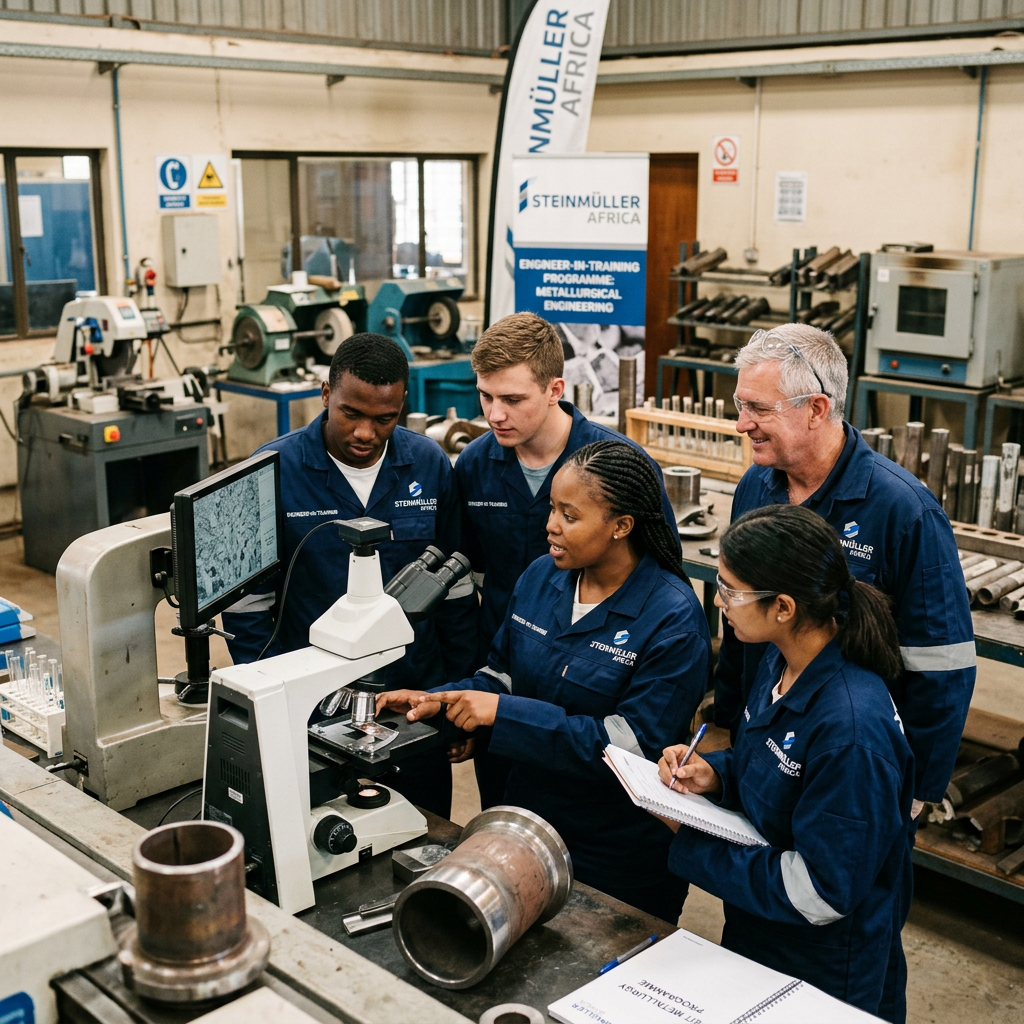
Steinmüller Africa Engineer-in-Training Programme for Metallurgical Engineering Graduates
Steinmüller Africa, a respected name in steam generation engineering and industrial services, has opened its Engineer-in-Training (EIT) Programme specifically for Metallurgical Engineering graduates, and for young engineers wanting structured, mentored exposure to real industrial engineering work, this is a genuinely credible way to start a technical career.
- Closing Date: 25 September 2026
- Location: Sandton, Gauteng, with required site visits mainly to Mpumalanga and Gauteng Provinces
- Salary/Stipend: Not disclosed publicly on the listing. However, benefits are confirmed to include pension, medical aid, an annual bonus, an anniversary bonus, and a long service bonus.
Programme Overview
The Engineer-in-Training programme is Steinmüller Africa’s structured pathway for turning strong metallurgical engineering graduates into fully capable, practically experienced engineers. Rather than a generic internship, this is a genuine EIT track built around Steinmüller Africa’s core industrial focus: steam generation engineering, a field where metallurgical expertise plays a genuinely critical role in material selection, failure analysis, and the lifetime performance of high-pressure boiler and pressure-part systems.
Being based in Sandton with site visits extending into Mpumalanga and Gauteng means EIT candidates gain a genuine mix of head-office structure and real, hands-on industrial site exposure, rather than being confined to a desk for the full duration of the programme.
Job Description
Successful candidates will be placed on a structured EIT programme, working alongside experienced engineers while being progressively exposed to real projects and site conditions. Given Steinmüller Africa’s specialisation in boiler pressure parts, welding technology, and steam generation systems, metallurgical engineering trainees can expect exposure to material behaviour, weld integrity, corrosion and failure analysis, and lifetime extension planning, all core concerns within the company’s industrial service offering.
Key Duties and Responsibilities
- Participate fully in the structured Engineer-in-Training development programme
- Undertake required site visits, mainly across Mpumalanga and Gauteng Provinces, to gain practical, on-the-ground engineering exposure
- Support metallurgical assessment, material evaluation, and failure analysis tasks under supervision
- Assist experienced engineers with projects tied to steam generation, boiler pressure parts, and related industrial systems
- Build practical understanding of welding and environmental technology processes relevant to the metallurgical field
- Contribute to lifetime extension planning and maintenance-related engineering tasks as guided by senior staff
- Maintain accurate technical records and documentation tied to assigned projects
- Take on additional job-related engineering tasks as reasonably required during the training period
Requirements and Qualifications
To be considered for this EIT programme, applicants need to meet the following criteria:
- Proof of successful completion of a B.Eng. or B.Sc. in Metallurgical Engineering
- A valid driver’s licence is advantageous, given the required site visits to Mpumalanga and Gauteng
- Willingness to travel to and work from various operational sites as needed during the programme
All academic results will be considered as part of the shortlisting process, so applicants should make sure their full academic record is submitted clearly alongside their application, rather than a partial or incomplete transcript.
Skills and Competencies
Steinmüller Africa is looking for graduates who show genuine technical readiness alongside a willingness to learn in a real industrial setting. Traits that tend to stand out include:
- Strong academic performance in Metallurgical Engineering, particularly in materials science and failure analysis coursework
- Genuine interest in industrial engineering, steam generation, and materials-related problem solving
- Willingness to travel and work across different site locations as part of the training experience
- Strong attention to detail, particularly important when assessing material integrity and failure conditions
- Good communication skills, useful when working alongside experienced engineers and site personnel
- A safety-conscious mindset suited to industrial site environments
- Genuine long-term interest in building a career in engineering within the power generation and industrial services sector
Why This Programme Is Worth Considering
For metallurgical engineering graduates, this kind of structured EIT placement offers something genuinely valuable: real exposure to how materials science applies in a live, high-stakes industrial setting, rather than confined to laboratory theory alone. Steinmüller Africa’s decades-long focus on boiler manufacturing and steam generation for South Africa’s power stations means EIT graduates are training within a company that understands metallurgical engineering at a genuinely deep, applied level. Confirmed benefits like pension, medical aid, and multiple bonus structures also signal a company genuinely invested in retaining and developing the engineers it trains, rather than treating the EIT programme as a short-term, disposable arrangement.
About Steinmüller Africa
Steinmüller Africa first entered the South African market in 1962, and for more than six decades it has played a central role in building and maintaining the country’s power generation infrastructure. The company fabricated boiler pressure parts for many of the iconic power stations that built South Africa’s national grid, and it remains an Original Equipment Manufacturer (OEM) to numerous Eskom power stations to this day, having supplied well over 20,000MW of steam generation capacity to the South African market since its founding.
Today, Steinmüller Africa offers comprehensive expertise across welding and environmental technology, manufacturing, maintenance, lifetime extension planning, and project management, alongside a wide range of cranes, lifting gear, welding equipment, and mobile offices for site establishment. All of these services are built around the company’s core industrial focus: steam generation. Steinmüller Africa forms part of the international Bilfinger Group, sharing ownership with local shareholder Torre Technologies (Pty) Ltd, and works closely alongside its sister company, Bilfinger Intervalve Africa, and close partner Eduardo Construction, to retain critical skills within the field.
Beyond its core engineering and manufacturing work, Steinmüller Africa has placed strong emphasis on developing the next generation of engineers through its structured EIT programmes across disciplines including Mechanical, Structural, Civil, Chemical, and Metallurgical Engineering, alongside Red Seal apprentice programmes and its own CPD-accredited Boiler Technology Course. For metallurgical engineering graduates looking to build a genuinely respected, technically demanding career in one of the country’s most established industrial engineering environments, Steinmüller Africa’s EIT programme offers a credible and well-structured route in.
How to Apply
Applicants should submit scanned copies of their CV, ID, and academic records with their initial application, with certified copies required later at the interview phase. Make sure your CV is focused specifically on your Metallurgical Engineering background, highlighting your degree, final-year project, any practical laboratory work, technical skills, and site exposure gained during your studies. If you hold a driver’s licence, make sure it’s clearly visible on your CV, since this is specifically flagged as advantageous for this role. Apply directly through Steinmüller Africa’s official application portal, and review all listed requirements carefully before submitting.
Eskom Learner Artisan Opportunities: Twelve (12) Positions Available at Matimba Power Station